The advice to “plant for pollinators” has become widespread, and most gardeners now make some effort to include nectar-rich flowers in their beds and borders. But a significant body of recent research has identified a problem with how this advice is usually interpreted: the focus on summer abundance, while well-intentioned, overlooks the periods when pollinators are most vulnerable.
A 2024 study from the Universities of Oxford and Exeter found that plant species widely recommended as “pollinator friendly” begin flowering up to a month too late in spring to support wild bee colonies at their most critical point. A separate study, published in the Proceedings of the Royal Society B in October 2024, found that gardens already provide 15 percent of all annual nectar in the surrounding farmland landscape, but between 50 and 95 percent of the nectar available during early spring and late summer, the two periods when farmland supplies collapse. The conclusion of both studies points in the same direction: the timing of when nectar is available matters far more than how much there is in total.
In the Oxford and Exeter study, adding early-blooming species to the landscape improved bumblebee colony survival rate from 35 percent to 100 percent. The plants included ground ivy, red dead-nettle, cherry, hawthorn, and willow: mostly unremarkable plants that most gardens could accommodate.
How pollinator needs shift through the year
To understand why timing matters so much, it helps to know something about how bumblebees, the most garden-dependent of our pollinators, move through the year.
Bumblebee colonies do not overwinter as a colony. In late summer and autumn, each colony produces new queens and males. After mating, the new queens feed heavily on pollen and nectar to build up fat reserves, then find a sheltered spot to hibernate underground or under dense vegetation, where they remain until late winter or early spring.
When a queen emerges from hibernation, she is carrying the future of her entire colony. She needs to find enough nectar and pollen within days to begin nest-building and laying eggs. If she finds nothing, the colony never starts. Some species, including the tree bumblebee (Bombus hypnorum), begin emerging as early as February. Others follow in March and April. All of them emerge into a landscape that is often still largely bare.
Later in the year, as summer gives way to autumn, next year’s queens and the last solitary bees of the season are feeding intensively to build the reserves that will carry them through winter. This second period, August to October, is the other moment when nectar supply falls sharply relative to demand.
The deep winter months, November to January, are a separate challenge. Most pollinators are dormant or hibernating, but on mild days, winter-active buff-tailed bumblebees (Bombus terrestris) have been found foraging in UK gardens, and any flower open in mid-winter provides a resource with essentially no competition.
The seasonal calendar
A note on double flowers. Throughout this guide, single-flowered varieties are recommended over double. This is because double flowers are produced by selectively breeding a plant so that its stamens and nectaries, the parts that produce pollen and nectar, are converted into extra petals. The result is a fuller bloom that has lost much of its reproductive function: less pollen and nectar is available, and what remains is often buried beneath layers of petals that insects cannot reach. This applies across many popular plants including dahlias, roses, hellebores, and ornamental cherries. When buying for wildlife value, always choose single-flowered varieties.
Winter November – January
This is the hardest gap to fill but also the one where a single plant can make the most disproportionate difference. Almost nothing flowers in the depths of winter, so any nectar source is immediately valuable to insects foraging on warm days.
Mahonia is the outstanding choice for this period. The large hybrid varieties such as Mahonia × media ‘Charity’ flower from November through to January, producing dense clusters of fragrant yellow flowers with abundant nectar. Mahonia aquifolium follows from late winter through to spring. Both tolerate shade, grow in almost any soil, and need very little attention once established. A single plant against a north or east-facing wall can provide the only meaningful nectar source in a garden for several months.
Winter heather (Erica carnea) is the other essential for this period. It begins flowering in November and can continue through to April, covering the deepest winter months reliably and with less fuss than almost any other plant. It grows well in containers, suits the front of a border, and requires only an annual trim after flowering to stay compact.
Hellebores (Helleborus spp.) flower from January through to April in a sheltered spot. Their flowers are rich in both nectar and pollen and are visited by early bumblebees and hairy-footed flower bees (Anthophora plumipes) on mild winter days. Choose single-flowered varieties: double-flowered hellebores are almost worthless to pollinators.
Early spring February – April
This is the most critical period, and the one where gardens can make the greatest difference relative to the wider landscape. Farm hedgerows and field margins are largely bare. Queen bumblebees are emerging from hibernation, desperately hungry, in a landscape that offers almost nothing.
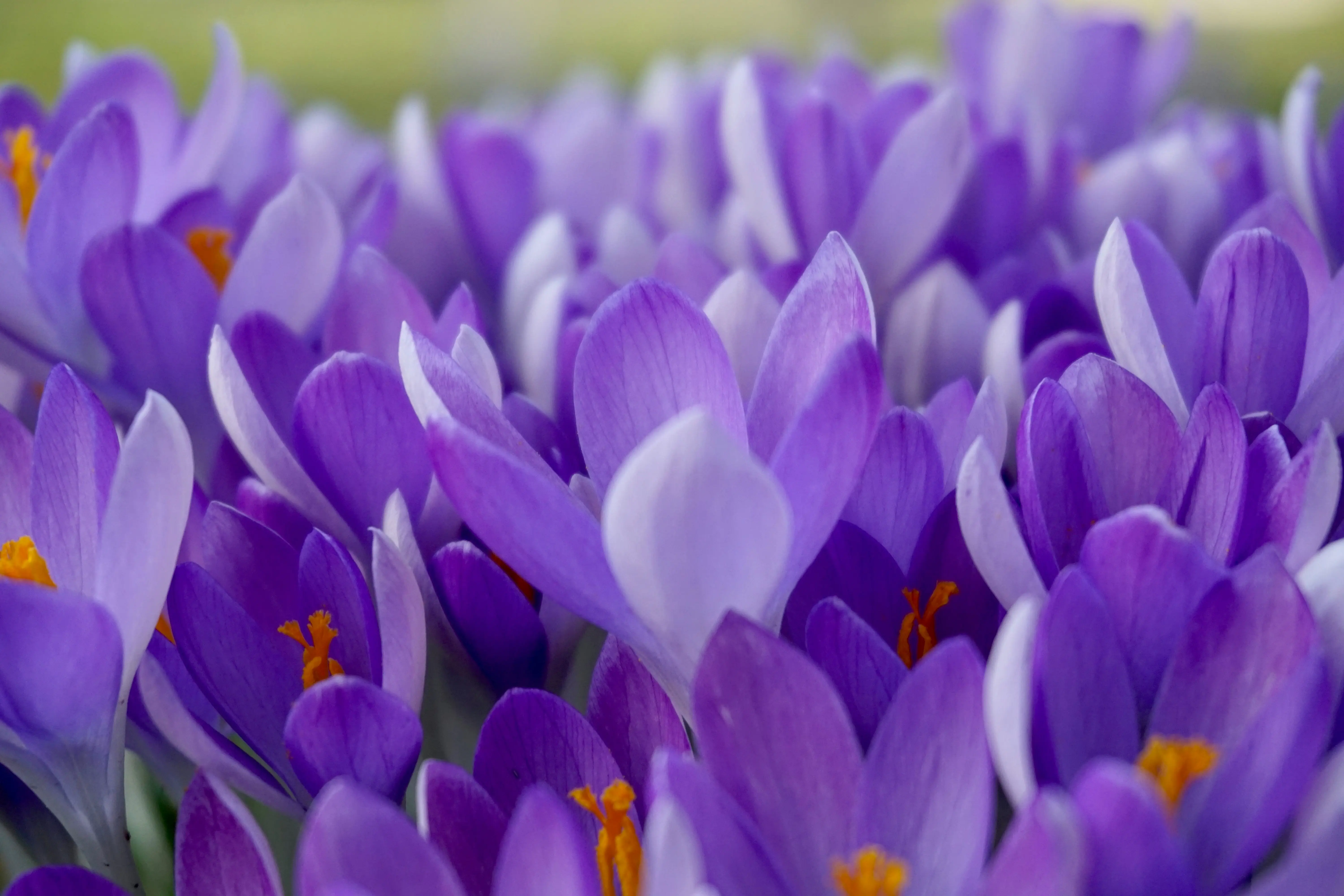
Crocus, particularly Crocus tommasinianus, is one of the most important things you can plant for early pollinators. It flowers in February and March, providing both nectar and pollen at a time when little else is open. C. tommasinianus naturalises freely in grass and in borders, spreads without becoming invasive, and costs almost nothing to establish. Plant in generous drifts rather than a scattering of individual corms: a group of fifty is far more useful to a foraging bee than ten spread across the garden.
Pulmonaria (Pulmonaria officinalis and related species) flowers from February through to April and is particularly valued by long-tongued bumblebees and hairy-footed flower bees, which can reach the nectar at the base of the tubular flower. It tolerates shade well, making it one of the most useful plants for difficult corners of the garden.
Snowdrops (Galanthus nivalis) offer nectar and pollen from January through to March and are visited by honeybees and early-emerging bumblebees. They are most effective planted in large groups under deciduous trees or hedges, where they naturalise over time.
Willows (Salix spp.) and blackthorn (Prunus spinosa) are among the most pollen-rich plants available in early spring and are important for mining bees, which emerge early and depend heavily on tree and shrub blossom. Blackthorn is an outstanding hedging plant for wildlife: it flowers in March and April before the leaves appear, and in autumn its sloes feed birds and mammals.
Do not remove dandelions from the lawn and borders in spring. Taraxacum officinale supports over 100 insect species and is one of the single most important nectar sources available to emerging pollinators in March and April. A patch of flowering dandelions in a neglected corner is worth more than a great deal of expensive specialist planting.
Late spring and summer May – July
This is the period that most pollinator planting advice focuses on, and with good reason: the range of available plants is enormous and the demand from pollinators is at its highest. The challenge here is less about filling a gap and more about ensuring that the garden covers a wide range of flower types to support the full diversity of pollinating insects, not just the most common bumblebees.
Comfrey (Symphytum officinale) flowers from April through to October and is outstanding for bumblebees. Its deep, bell-shaped flowers are perfectly suited to long-tongued species, and a single plant in flower is often covered in bees. It also acts as a powerful fertiliser when cut and composted, making it one of the most versatile plants in any garden.
Phacelia (Phacelia tanacetifolia) is arguably the single most effective annual to sow for bees. It establishes rapidly from seed, begins flowering within weeks of sowing, and can be sown in successive batches from April to July for a continuous supply of flowers through summer. Its open, accessible flowers suit a wide range of bee species including many smaller solitary bees and hoverflies.
Borage (Borago officinalis) is another fast-growing annual with exceptional wildlife value. It produces star-shaped blue flowers from May through to the first frosts if left to self-seed, which it does readily. It attracts bumblebees in particular and is a reliable self-sustaining plant once established in a border.
Field scabious (Knautia arvensis), one of Britain’s finest native wildflowers, flowers from June to September and is consistently rated among the highest-performing nectar plants for combined bee and butterfly support. It establishes readily from seed and thrives on well-drained, low-fertility soils.
Foxglove (Digitalis purpurea) flowers from May to July and is a specialist bumblebee plant. Its tall, tubular flowers suit long-tongued species and bumblebees are often the only insect you will see inside them. It is a native biennial that self-seeds freely in open ground and light shade.
Lavender (Lavandula angustifolia) is reliable, long-lived, and flowers from June to September. It supports bees, butterflies, and hoverflies and thrives in the dry, sunny conditions common in Suffolk gardens. Plant in a sunny, well-drained spot and trim after flowering to keep it compact.
Autumn August – October
As summer flowers fade, the garden can easily become a nectar desert just as the second hungry period begins. Next year’s bumblebee queens are feeding to build winter fat reserves. The last solitary bees of the season are active. Late-flying butterflies, including red admirals and commas, are searching for energy before the cold arrives. A few well-chosen late-flowering plants can carry enormous weight at this time of year.
Aster (Symphyotrichum spp., formerly Michaelmas daisy) is one of the most important plants you can grow for autumn pollinators. It flowers from August through to November, well into the period when almost nothing else remains, and a single established clump will be covered in bees, hoverflies, and butterflies on any warm autumn day. The native-origin species and single-flowered varieties are far more accessible to insects than highly bred show varieties.
Sedum, now correctly Hylotelephium spectabile, flowers from August to October and consistently attracts more pollinators per square metre than almost any other garden plant. On warm September days it is not unusual to count several species of bumblebee, multiple hoverfly species, and red admiral butterflies on a single plant. It is drought-tolerant, thrives on poor soil, and asks very little of the gardener.
Verbena bonariensis flowers from July through to October and is outstanding for butterflies, which can access its small flowers easily. It self-seeds prolifically and once established will maintain itself in a border indefinitely. Its tall, open habit means it can be threaded through other plantings without taking much space.
Ivy (Hedera helix) is the single most important plant of the entire autumn period and arguably the most undervalued plant in the British garden. It flowers from September through to November, or later in mild years, producing abundant, accessible nectar at a time when almost everything else has finished. More than 140 species of insect and 17 species of bird use ivy in Britain. There is even a specialist bee entirely dependent on it: the ivy bee (Colletes hederae), which times its annual emergence precisely to the opening of ivy flowers in September.
Established ivy growing up a wall, fence, or tree needs no management to provide this value. Ivy only flowers on mature, established growth. Young or frequently cut ivy produces no flowers and therefore no nectar or berries. If you have ivy on a boundary and have been cutting it back hard, leaving some of it to mature is one of the simplest and most effective things you can do for autumn wildlife.
During early spring and late summer, when farmland nectar supplies collapse, gardens provide between 50 and 95 percent of the nectar available to bumblebees in the surrounding landscape. Over 90 percent of farmland in Great Britain is within 1 km of a garden. (Proceedings of the Royal Society B, October 2024.)
A note on flower type
Not all flowers are equally accessible. Double-flowered varieties, bred to produce extra petals, typically block access to pollen and nectar and are of little or no use to pollinators. A double-flowered dahlia, for example, is essentially useless, while a single-flowered variety of the same species is excellent. The same applies to double hellebores, roses, and many ornamental cultivars. When buying plants for pollinator value, choose single-flowered varieties wherever possible.
Flower shape also matters. Long, narrow, tubular flowers are only accessible to long-tongued insects. Lavender, foxglove, and pulmonaria are examples of plants where the tube length limits which species can feed. This is not a reason to avoid them, but it is a reason to include a range of flower shapes across the garden: flat, open flowers such as phacelia, sedum, and asters reach the widest range of pollinators, including smaller solitary bees and hoverflies that cannot access tubular flowers at all.
Practical considerations
Plant in groups
A single specimen of even the best pollinator plant is far less effective than a group of five or ten. Pollinators forage most efficiently when flowers are concentrated: a patch of fifty crocus corms, a metre-wide clump of asters, or a dense row of lavender is worth far more than the equivalent number of plants scattered singly across a garden. Where space is limited, it is better to grow a generous amount of fewer species than a single example of many.
Small gardens and containers
Many of the most important plants work in containers. Winter heather, crocus, and pulmonaria make an excellent early-season pot combination that can be placed on a doorstep or balcony where it will be visited by bees foraging on mild late-winter days. Lavender, phacelia, and borage all perform well in containers through summer. The critical late-season plants, aster and sedum, are compact enough for a large pot and will flower reliably for years.
Resist deadheading in autumn
Leaving seed heads on asters, echinacea, rudbeckia, and verbena through autumn and winter benefits birds as well as insects. Goldfinches in particular are attracted to the seed heads of teasel and verbena. Cutting everything back in October removes both late nectar and a winter food source that costs the gardener nothing to provide.
In Suffolk
Suffolk’s sandy soils and warm, dry summers make it one of the better counties for growing pollinator plants. Several of the highest-value species thrive on the light, free-draining conditions that can challenge other crops. Lavender, sedum, phacelia, and field scabious all perform particularly well, often better than in heavier soils elsewhere.
Viper’s bugloss (Echium vulgare) is worth a special mention for Suffolk gardeners. It is consistently rated among the highest-performing native bee plants in the country, attracting an exceptional range of species, and it is genuinely at home in the sandy, open conditions of Suffolk’s Sandlings and Brecks. It is a biennial: sow it in summer for flowers the following year, and leave it to self-seed once established.
The Sandlings heathland and the Brecks to the north and west support nationally important populations of rare solitary bees that depend on open, sandy ground with a reliable sequence of flowering plants through the season. Gardens in and around these landscapes have a particular role to play in extending the nectar corridor beyond managed nature reserves.
Further reading
-
RHS Plants for Pollinators (rhs.org.uk/plants-for-pollinators)
The Royal Horticultural Society's evidence-based list of plants rated for pollinator value, searchable by plant type, flowering period, and size. The backbone of any research-led planting scheme: use it to verify which plants in your existing garden score highly and to fill gaps in the seasonal sequence. -
Plantlife (plantlife.org.uk)
Runs the Every Flower Counts citizen science survey and No Mow May campaign. Publishes data on nectar density across lawn management regimes and species lists for wildflower meadow creation. Their Super Plants report identifies the UK's highest-value nectar sources by measured output rather than anecdote. -
Bumblebee Conservation Trust (bumblebeeconservation.org)
Detailed planting advice organised by bee species and season, along with practical guidance on creating continuous forage across the year. Includes information on landscape-scale connectivity and how individual gardens contribute to pollinator corridors. -
UK Pollinator Monitoring Scheme (ukpoms.org.uk)
The national citizen science scheme for recording pollinators, coordinated by the UK Centre for Ecology and Hydrology. Submitting transect counts from your garden contributes directly to national trend data and helps track whether garden planting changes are reflected in pollinator populations over time. -
Suffolk Wildlife Trust (suffolkwildlifetrust.org)
Local guidance on planting for pollinators in Suffolk, with specific reference to the Sandlings, Brecks, and river valley habitats that support some of the county's rarest bee and hoverfly species. Includes contact details for the Suffolk Biological Information Service.