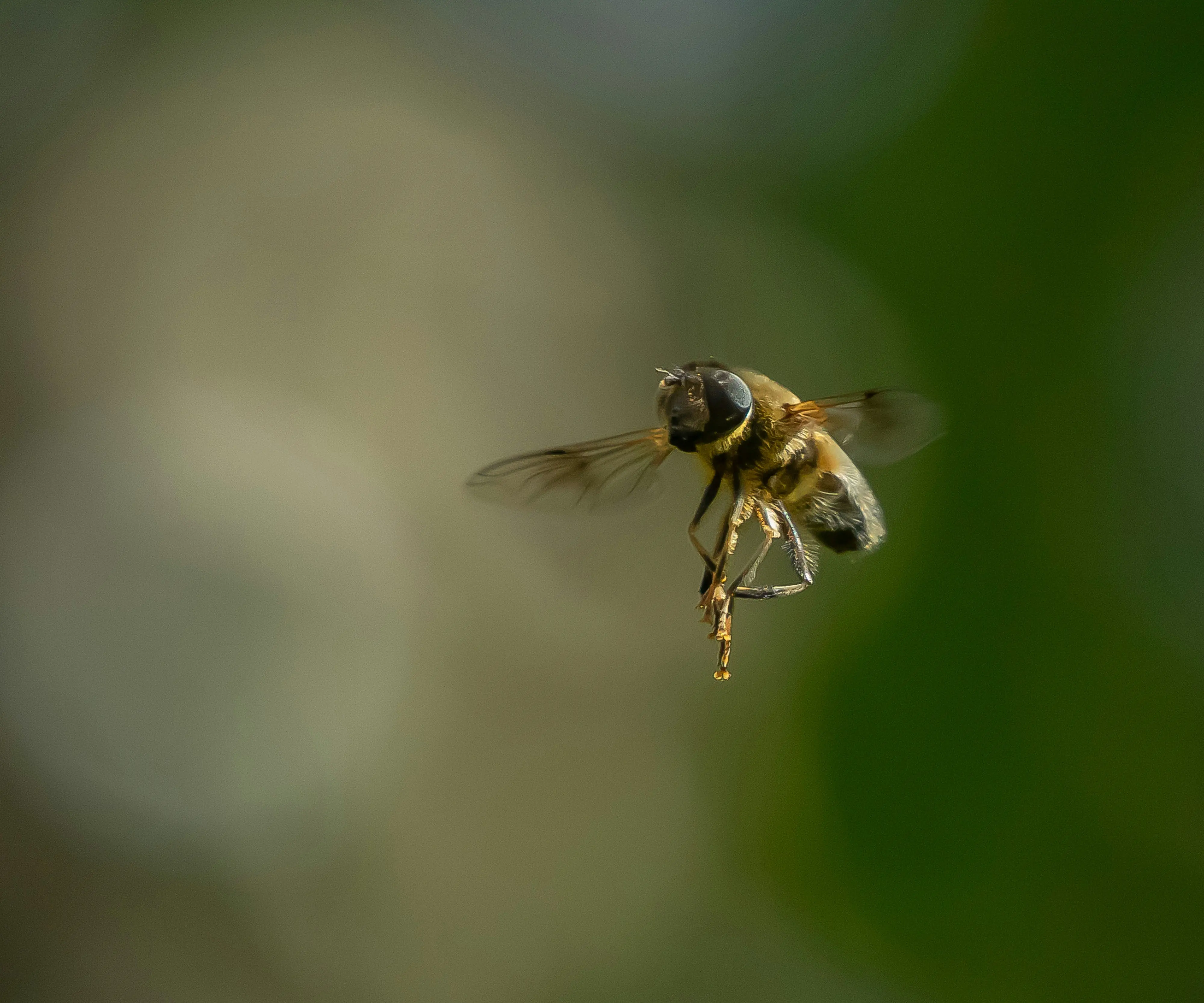
Hoverflies are the garden’s most overlooked allies. They are present in almost every garden throughout the warmer months, visiting flowers alongside bees, hovering above paths and borders, and laying eggs in aphid colonies. Most gardeners walk straight past them, convinced they are looking at a wasp or a bee. That misidentification is the point: many hoverflies have evolved to look convincingly like stinging insects, and the deception works on birds and people alike.
Separating them from the insects they mimic takes only one observation, and once you have made it you cannot miss it. Hoverflies are true flies, members of the order Diptera. Like all true flies, they have only one pair of wings. Bees and wasps have two pairs. A hovering insect that holds its position with the locked stillness of a miniature helicopter before shooting sideways and hovering again is always a hoverfly. No bee or wasp moves in that way. The hovering behaviour is so distinctive that the family takes its name from it.
Once you start looking, the diversity is striking. Britain has over 280 hoverfly species, from the tiny dark Melanostoma that covers umbellifers in summer to the large, spectacular Volucella zonaria, a hornet mimic that would stop most people in their tracks. A well-planted suburban garden probably supports forty or more hoverfly species across the course of a season, most of them unidentified and almost entirely unappreciated.
How to identify a hoverfly
The single-wing test settles most cases. When the insect is at rest, look for the way it holds its body: hoverflies have a noticeably flat, wide abdomen in many species, and their eyes are large and dome-shaped, covering most of the head. In males of many species the eyes meet in the middle, filling the entire forehead. The antennae are short and stubby, quite different from the longer, more prominent antennae of bees.
The characteristic hover is the easiest field mark of all. Territorial male hoverflies hold a fixed point in the air for many seconds at a time, occasionally darting to intercept rivals or investigate passing objects, then returning to exactly the same spot. This behaviour is almost never seen in bees or wasps, which move more purposefully between flowers and do not maintain stationary positions in open space.
In flight, the lack of a waist is another useful clue. Wasps have a strongly constricted abdomen visible even at a distance. Hoverflies do not, and this distinguishes the wasp-mimicking species from the real thing once you are looking for it.
The art of mimicry
Many British hoverflies have evolved to resemble bees or wasps. This is Batesian mimicry: a harmless species gains protection by resembling a harmful one. Predators that have learned to avoid the sting of a bumblebee or the bite of a wasp will also avoid the hoverfly that resembles them. The hoverfly gains safety without paying the costs that come with producing venom. It is an entirely passive strategy.
Hoverflies are completely harmless to people. They cannot sting. The apparent aggression of a large hoverfly hovering close to a face is territorial behaviour between males, and the insect has no way of harming the observer. A moment of stillness and it will move on. Understanding this changes the garden experience considerably.
Britain has some remarkable mimic species. Volucella bombylans is perhaps the most impressive: it comes in two distinct colour forms, one matching the red-tailed bumblebee (Bombus lapidarius) and the other matching white-tailed bumblebees including Bombus lucorum. The two forms were described as separate species before the relationship was understood. The drone fly (Eristalis tenax) is a very convincing honeybee mimic and is probably the hoverfly most often mistaken for a bee in British gardens, appearing regularly on fennel and ivy from summer through to autumn.
The second pollinators
A 2020 study published in the Proceedings of the Royal Society B analysed pollinator visits across hundreds of crops worldwide and found that true flies, the order Diptera which includes hoverflies, visit 72% of global food crop species. The value of their pollination services is estimated at around $300 billion per year. Hoverflies form the majority of those fly visits and are routinely described as the second most important group of pollinators after bees.
For the food grower, this matters directly. Hoverflies visit courgettes, squashes, onion flowers, fennel, and fruit tree blossom regularly. They are generalists in the best sense: where many bees have preferences for particular flower types or depths, hoverflies move freely between species, carrying pollen across a wide variety of plants in a single foraging session.
Hoverflies are active in cooler and cloudier conditions than many bee species, extending pollination into early spring mornings and overcast days when bumblebees may remain grounded. In the gap between winter and the first reliable bee weather, hoverflies are often the primary pollinators working the garden.
Their mouthparts are the key to understanding their flower preferences. Most hoverflies lack the elongated tongue of a bumblebee and cannot reach nectar in deep or tubular flowers. They are instead drawn strongly to flowers that present nectar and pollen openly: flat or gently domed heads composed of many small individual flowers. This is why umbellifers, the family that includes fennel, wild carrot, and angelica, attract so many of them. The flat platform of a fennel flowerhead provides dozens of accessible nectar sources in one place, and on a warm July day a single plant in full flower can hold ten or more hoverfly species simultaneously.
Pest controllers in the making
The adult hoverfly is what gardeners see. The larva is what does the pest control work. Around 40% of British hoverfly species have larvae that prey on aphids, and the scale of the service they provide is frequently underestimated. Conservation bodies including the RHS and the Bumblebee Conservation Trust note that hoverfly larvae are as important as ladybirds in keeping aphid populations in check across gardens and farmland.
The marmalade fly (Episyrphus balteatus) is probably the most prolific aphid predator. Females actively seek out large aphid colonies and lay their eggs among them. When the larvae hatch, they are semi-transparent, slug-like creatures that move slowly through the colony, gripping individual aphids and consuming them one by one. A single larva can eat hundreds of aphids before it is ready to pupate. On a plant with a heavy aphid infestation, a gardener who looks closely will often find these larvae already present and already working.
This is one of several reasons why broad-spectrum insecticides are counterproductive even when the problem they are aimed at is a genuine aphid infestation. The larvae working through that infestation are more effective, more targeted, and entirely free. Applying an insecticide removes both the aphids and the mechanism that would have controlled them.
The larval world
Hoverfly larvae live lives almost completely hidden from gardeners, and the range of habitats they occupy is far wider than most people expect.
Aphid predators
The aphid-feeding larvae of Episyrphus, Syrphus, and related genera are the most familiar, though they are rarely noticed. They are tapered at the head end, legless, and semi-transparent, which makes them very easy to overlook on a stem already covered in green or black aphids. Finding them is worth a moment of attention: they are a sign that the garden’s food web is functioning without any intervention required.
Detritivores and aquatic larvae
Many hoverflies in the Eristalis and Helophilus groups have larvae that live in wet, organically rich conditions. The drone fly larva, commonly known as the rat-tailed maggot, can live in stagnant or semi-stagnant water and in the liquid that accumulates at the base of compost heaps and manure piles. It breathes through a long, telescoping respiratory tube that can extend up to 15 centimetres, acting as a snorkel while the larva is submerged. This entirely harmless creature is the reason that creating a hoverfly lagoon is one of the most recommended simple habitat actions for gardens: a small container of water with rotting organic matter provides exactly what these species need to complete their life cycle.
Dead-wood feeders
Several species in the Criorhina and Xylota groups have larvae that live inside rotting wood, particularly wet and mossy decaying stumps. These species have become considerably less common as dead wood is routinely cleared from gardens and managed woodland. A log pile left to decay over several years, particularly in a part-shaded spot where it can stay damp, provides the conditions they need and supports a range of other invertebrates at the same time.
Guests in bumblebee nests
Volucella species have the most unusual larval strategy. Their larvae live inside active bumblebee and wasp nests, feeding on debris, dead larvae, and nest material. The adult female enters the nest to lay her eggs, apparently accepted by the colony rather than expelled. The relationship is broadly commensal: the hoverfly benefits, and the bee colony is largely unaffected. It is a remarkable adaptation and one reason why an undisturbed garden with nesting bumblebees is likely to also support Volucella species.
Why numbers are falling
The average decline in geographic range for bee and hoverfly species combined across Britain between 1980 and 2013, recorded across more than 19,000 one-kilometre squares. Published in Nature Communications, 2019.
A peer-reviewed study published in Nature Communications in 2019 tracked pollinators across more than 19,000 kilometre squares in Britain and found that the combined geographic range of bee and hoverfly species had declined by a quarter on average between 1980 and 2013. One in three of the species surveyed showed net decline across this period. The scale of loss is consistent with what has been found for other insect groups, and the causes are broadly the same.
Loss of flowering plants is the primary driver for adult hoverflies. The collapse of wildflower-rich grassland, hay meadows, and hedgerow margins has removed the nectar supply that adult hoverflies depend on. Unlike some specialist pollinators, hoverflies are generalists and will use a wide range of flowering plants, but a landscape that provides flowers only in gardens and roadside verges is a far poorer resource than one with flowers across the wider countryside.
Pesticides pose both a direct and indirect threat. Insecticides kill hoverflies and their larvae directly. Herbicides remove the plants they feed on. Several agricultural fungicides and insecticides have been shown to affect the development and survival of fly larvae even at low concentrations.
Loss of wet habitats and dead wood affects the species whose larvae depend on these environments. Drainage of wetlands and ditches reduces breeding habitat for aquatic-larval species in the Eristalis group. The removal of old trees, veteran timber, and dead wood from gardens and managed countryside eliminates the breeding sites of dead-wood hoverflies, which are among the more specialised and vulnerable members of the family.
Hoverflies in Suffolk
Suffolk’s landscape offers a varied set of hoverfly habitats. The county’s network of slow-moving rivers, dykes, and wet grazing marshes, particularly in the Waveney Valley, the Blyth estuary catchment, and the coastal levels between Aldeburgh and Kessingland, provides productive breeding habitat for aquatic-larval species including drone flies and Helophilus. These habitats are well watched by entomologists and regularly produce records of less common species.
The Sandlings heathland, with its warm open ground and flowering scrub, supports a range of hoverflies typical of dry, sandy habitats. The county’s mix of arable margins, hedgerows, and gardens, however degraded compared to historical baselines, still provides a working network of foraging habitat for the generalist species that make up the bulk of most garden hoverfly communities.
Hoverfly sightings from Suffolk can be submitted to the Suffolk Biodiversity Information Service at suffolkbis.org.uk, which coordinates invertebrate recording across the county. Records also feed into the national Hoverfly Recording Scheme via iRecord at irecord.org.uk. Photography is very helpful for identification: a clear image of the abdomen pattern is usually sufficient for the commoner species.
Flowers for hoverflies by season
Spring Mar – May
The early season matters more than it might appear. Several hoverfly species overwinter as adults and are active from March onwards, well ahead of most bumblebee activity. Cow parsley flowering along hedgerows and road margins from April is a significant early resource. In the garden, phacelia (Phacelia tanacetifolia) sown in March produces flowers by April or May and is one of the most reliably effective early-season plants for hoverflies and bees combined. Alliums, flowering onions and ornamental garlic, open in late spring and attract a wide range of hoverfly species to their globe-shaped heads. Any fruit tree blossom is valuable; apple and cherry blossom in particular coincides with the emergence of early-flying hoverflies.
Summer Jun – Aug
The peak season for hoverfly diversity. This is when umbellifers come into their own. Fennel is arguably the single most valuable garden plant for hoverflies: its broad, flat yellow flowerheads in July and August draw extraordinary numbers and diversity of species. Wild carrot, angelica, and any carrot, parsnip, or parsley allowed to flower in its second year provide the same flat-platform structure. Calendula (pot marigold), in single-flowered varieties, provides continuous open-faced flowers throughout summer and is reliably visited. Single-flowered dahlias are excellent from July onwards. Knapweed (Centaurea nigra), a native meadow plant easily grown from seed, is outstanding for both hoverflies and bees from July through to September.
Avoid double-flowered forms of any species when planting for hoverflies. The extra petals of double flowers reduce or block access to the pollen and nectar that hoverflies need, and most double varieties attract a fraction of the insect visitors seen on single-flowered equivalents. The choice between a double dahlia and a single one is straightforward once you have watched both on the same afternoon.
Autumn Sep – Oct
Often overlooked, autumn is genuinely important for hoverflies. Several species remain active into October, and the drone fly is commonly seen well into November on mild days. Ivy is the critical plant: its small, open flowers from September onwards are intensively used by hoverflies as well as bees. A garden with established ivy on a wall or fence, or as ground cover in a shaded area, is providing something close to irreplaceable. Asters and sedums extend the season further.
Habitat: beyond flowers
Providing flowers supports adult hoverflies. Supporting the next generation requires thinking about where larvae can develop. Three additions make a substantial difference.
A log pile is the most straightforward and most broadly useful. Stack damp, reasonably large-diameter logs in a shaded or part-shaded corner and leave them undisturbed for years. As the wood softens and fungal growth takes hold, the conditions for dead-wood hoverfly larvae develop. Size and age matter more than neatness: a large, soggy, moss-covered pile is more valuable than a tidy stack of fresh wood.
A compost heap provides breeding habitat for detritivore species whose larvae live in decomposing organic matter. An established heap that is not turned during summer is ideal. The decomposition taking place inside it is exactly what some hoverfly species seek out when laying eggs.
A hoverfly lagoon is a simple, low-cost addition recommended by several conservation organisations including the Wildlife Trusts. Take any container between 10 and 30 litres, fill it roughly two-thirds with water, and add a generous mix of fresh grass cuttings and other green organic material. Place it in a sunny spot, leave the lid off, and allow the contents to begin decomposing into a slightly stagnant slurry. Drone fly females will find the container within days and lay eggs in the liquid. The rat-tailed maggot larvae that hatch are entirely harmless and will develop in the container over several weeks. Place a short length of wood leaning against the inside of the container so that the mature larvae can crawl out when they are ready to pupate. Top up with water occasionally to prevent the container drying out. No further maintenance is needed.
Avoiding harm
- Use no insecticides. Broad-spectrum insecticides kill hoverflies and their larvae alongside the target pest. Aphid infestations in a garden that supports hoverflies typically resolve themselves within two to three weeks as larval populations build up in response. Intervening removes both the aphids and the mechanism that would have controlled them naturally.
- Avoid double-flowered plants for hoverflies. Double-flowered forms of rose, dahlia, poppy, and many other garden plants have reduced or inaccessible nectar and pollen. Single-flowered equivalents attract consistently more hoverflies and other pollinators. Where both forms are available, choose the single.
- Leave log piles and compost heaps undisturbed in summer. Turning a compost heap or disturbing a log pile between May and August disrupts developing hoverfly larvae as well as other invertebrates and possibly nesting bumblebees. Leave established piles alone through the warmer months.
- Allow some plants to bolt and flower. Carrots, parsnips, parsley, and fennel left to flower in their second year provide outstanding late-season umbellifers at no cost. A single bolted fennel plant in late July is often the best hoverfly plant in a kitchen garden.
- Keep ivy. Ivy on walls, fences, and trees is frequently removed as a matter of habit. Its autumn flowers are among the most important late-season resources available in British gardens for hoverflies, bees, and other insects. Managed ivy on a wall causes no structural damage to sound pointing and provides significant ecological value across the year.
Common garden hoverflies: a quick guide
Several minutes of observation on a warm day between April and October, with the sun on a patch of flowering fennel, phacelia, or knapweed, will usually produce multiple hoverfly species. The five species below are the ones you are most likely to meet in a Suffolk garden.
Marmalade fly
Episyrphus balteatusYear-round (commonest Mar – Oct)
Britain’s most common hoverfly. Distinctive alternating narrow and wider dark bands on an orange abdomen. Migrates in large numbers from mainland Europe each summer, boosting UK populations. Larvae are among the most effective aphid predators in the garden. Found on almost any open flower.
Drone fly
Eristalis tenaxMar – Nov (sometimes in mild winter)
Large and robust, a convincing honeybee mimic with a brown and yellow patterned abdomen. One of the most frequently seen hoverflies in UK gardens. Common on fennel, ivy, and late-flowering asters. Larvae are rat-tailed maggots living in wet organic matter.
The footballer
Helophilus pendulusApr – Oct
Named for the yellow and black striped pattern on its thorax. One of the most easily identified hoverflies in the field. Often seen near water or damp ground. Larvae live in wet, organically rich conditions. Visits umbellifers and open-faced flowers throughout summer.
Bumblebee hoverfly
Volucella bombylansMay – Aug
Britain’s most convincing bumblebee mimic, in two colour forms matching different bumblebee species. Quite large for a hoverfly. Larvae live inside active bumblebee and wasp nests. A garden with nesting bumblebees is likely also supporting this species.
Slender hoverfly
Melanostoma scalareApr – Oct
Small and easily overlooked, with narrow yellow spots on a dark abdomen. Very common on umbellifers and open-faced flowers throughout summer. One of the most abundant hoverfly species in Britain, present on almost every patch of flowering fennel, angelica, or knapweed.
The standard reference for British hoverfly identification is British Hoverflies by Alan Stubbs and Steven Falk, published by the British Entomological and Natural History Society. Steven Falk has also made an extensive set of identification resources freely available at stevenfalk.co.uk. The iNaturalist app and iRecord both have active UK hoverfly communities that help with identification from photographs.
Further reading and recording
-
Hoverfly Recording Scheme (hoverfly.org.uk)
The national scheme for all 280+ UK hoverfly species, coordinated through the Biological Records Centre. Species accounts, distribution maps, and an online records portal. The primary place to submit UK hoverfly sightings. -
iRecord (irecord.org.uk)
The national online recording system. Hoverfly records submitted here feed directly into the Recording Scheme’s national dataset and are verified by expert reviewers. Also accepts photographs for assisted identification. -
Suffolk Biodiversity Information Service (suffolkbis.org.uk)
The county biological records centre. The primary place to log Suffolk invertebrate sightings, including hoverflies. Records contribute to the county’s biodiversity monitoring and Local Nature Recovery Strategy. -
Dipterists Forum (dipterists.org.uk)
The specialist society for British fly recording, including hoverflies. Publishes identification guides, keys, and the Dipterists Digest journal. An active community for anyone who wants to go further with fly identification. -
RHS hoverfly pages (rhs.org.uk/biodiversity/hoverflies)
Practical gardening guidance on attracting hoverflies, with plant recommendations and identification notes for common garden species. -
British Hoverflies (Stubbs & Falk, BENHS)
The standard identification guide for all British hoverfly species. Comprehensive keys and descriptions. The definitive reference for anyone who wants to identify hoverflies beyond the common garden species.