Insect pollination contributes an estimated £630 million per year to the UK economy. Around 85% of the apple crop and 45% of the strawberry crop depend on it. Tomatoes cannot set fruit without physical vibration of their anthers, a service that only bumblebees and some solitary bees can provide. Courgettes, peppers, blueberries, and most soft fruits rely heavily on bee visits for yield and fruit quality.
The bees providing these services are, in many cases, in serious trouble. Not all of them, not equally, and not for simple reasons, but the overall picture across wild bee species in Britain is one of substantial long-term decline, and 2024 was the worst single year for bumblebees since monitoring began. Understanding which species are involved and what drives the problem is the starting point for doing anything useful about it.
Not just the honeybee
The honeybee (Apis mellifera) is the species most people picture when they hear the word bee. It lives in large managed colonies, produces honey, and is kept by beekeepers across the country. Its numbers in Britain are broadly maintained by human management and are not the story of pollinator decline.
Britain has 270 species of bee in total: 24 bumblebees, one honeybee, and around 245 solitary bees. Over 90% of British bee species are solitary. These are the species under pressure. The wild bees, the ones that evolved alongside British plants and have been here far longer than managed honeybees, are the ones whose numbers are falling.
This distinction matters for how we think about the problem. Campaigns focused narrowly on honeybees can draw attention and resources away from the wild species most in need. A garden managed for wild bees looks very different from one managed for honeybee keeping, and the ecological value is almost entirely in the former.
The bees in your garden
Bumblebees
Britain’s 24 bumblebee species are the most visible and well-studied of our wild bees. They are social insects, living in annual colonies founded each spring by a single queen emerging from hibernation. She will have mated the previous autumn and spent the winter buried in loose soil or leaf litter, often in a north-facing bank where temperatures are more stable. A queen buff-tailed bumblebee (Bombus terrestris) must weigh at least 0.6g to have enough fat reserves to survive the winter. Those that go into hibernation underweight do not make it to spring.
The colony establishment phase, from the queen’s emergence in February or March until her first workers hatch, is the most critical and vulnerable point in the bumblebee year. During this period the queen is functioning entirely alone: foraging for nectar and pollen, incubating her eggs by vibrating her flight muscles, and keeping her larvae fed without any assistance. She has not eaten since the previous summer. A cold or wet spell at this point, or a shortage of early flowers, can end a colony before it has truly begun.
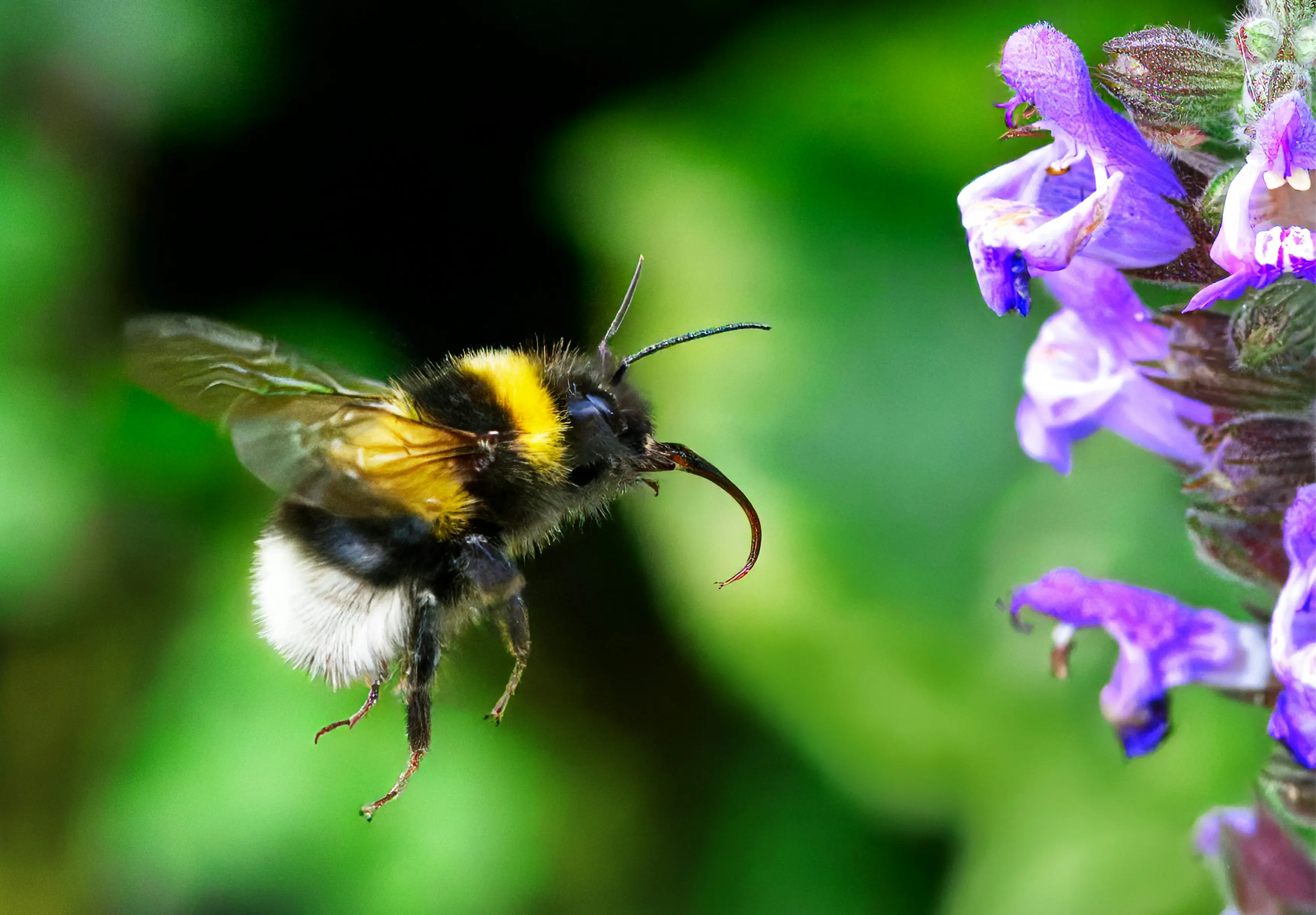
Different bumblebee species have markedly different ecological roles. The garden bumblebee (Bombus hortorum) has the longest tongue of any British bumblebee and is uniquely effective at pollinating deep-tubed flowers: foxglove, red clover, honeysuckle, vetches, and comfrey. It visits around 18 flowers per minute, more than shorter-tongued species, because its tongue reaches the nectar without probing. It is the primary bumblebee pollinator of runner beans. Shorter-tongued bumblebees, including Bombus terrestris, often respond by biting a hole near the base of tubular flowers to rob nectar without pollinating.
Eight of Britain’s 24 bumblebee species are listed on at least one conservation priority species list due to large population declines. The great yellow bumblebee (Bombus distinguendus), once found across most of Britain, has lost 98% of its former range and is now confined to the Outer Hebrides, Orkney, and a handful of coastal sites on the far north of mainland Scotland. The short-haired bumblebee (Bombus subterraneus) was last recorded in Britain in 1988 and declared extinct in 2000. A reintroduction programme using queens from Sweden has been running since 2012, across 850 hectares of restored habitat in south Kent. The species remains rare and confined to its release sites.
Mining bees
Mining bees (Andrena species) are the largest genus of solitary bees in Britain, with over 60 species. They are entirely harmless, do not form colonies, and each female excavates her own burrow independently, sometimes to a depth of 20 to 30 centimetres. She provisions each cell with a ball of pollen and nectar, lays a single egg, and seals the cell. The larva feeds, overwinters as an adult in the sealed cell, and does not emerge until the following spring. The female dies before her offspring hatch.
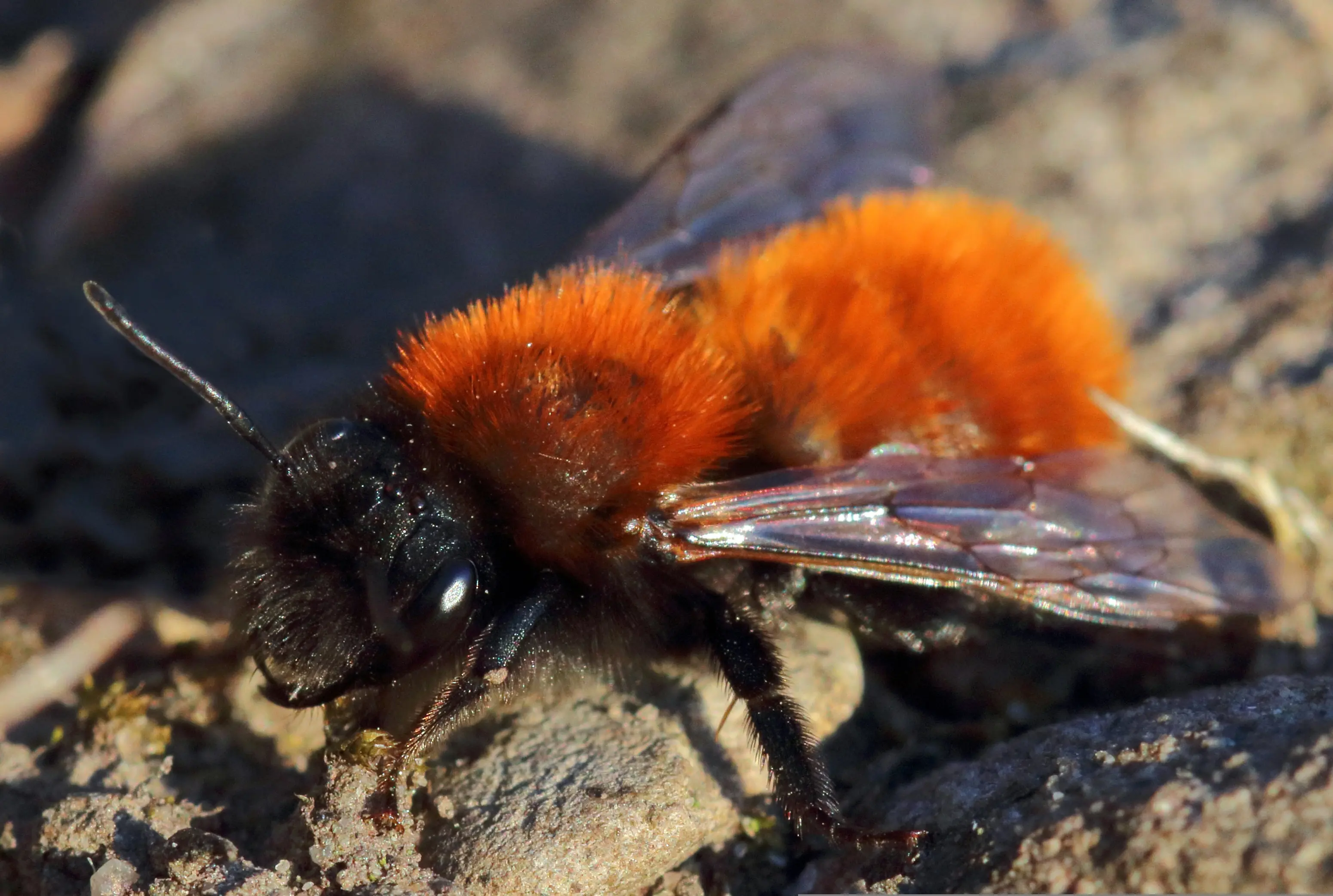
The most visible mining bee in gardens is the tawny mining bee (Andrena fulva). The female is an unmistakable rusty orange-red; the male is smaller and darker. Their nest entrances, small conical mounds of spoil appearing in lawns and bare soil in April, are often mistaken for ants or worms. They are harmless and short-lived: the flight season runs from April to June, peaking in April and May, timed to coincide with fruit tree blossom, blackthorn, and willows. Willow catkins are particularly important as an early pollen source, and several mining bee species including Clarke’s mining bee (Andrena clarkella) and the sallow mining bee (Andrena praecox) are specialist willow-feeders that emerge specifically to coincide with willow flowering in early spring.
Mason bees and leafcutter bees
There are around 20 species of mason bee (Osmia) in Britain and seven species of leafcutter bee (Megachile). These are the cavity-nesting solitary bees most associated with bee hotels, and they respond readily to well-designed provision.
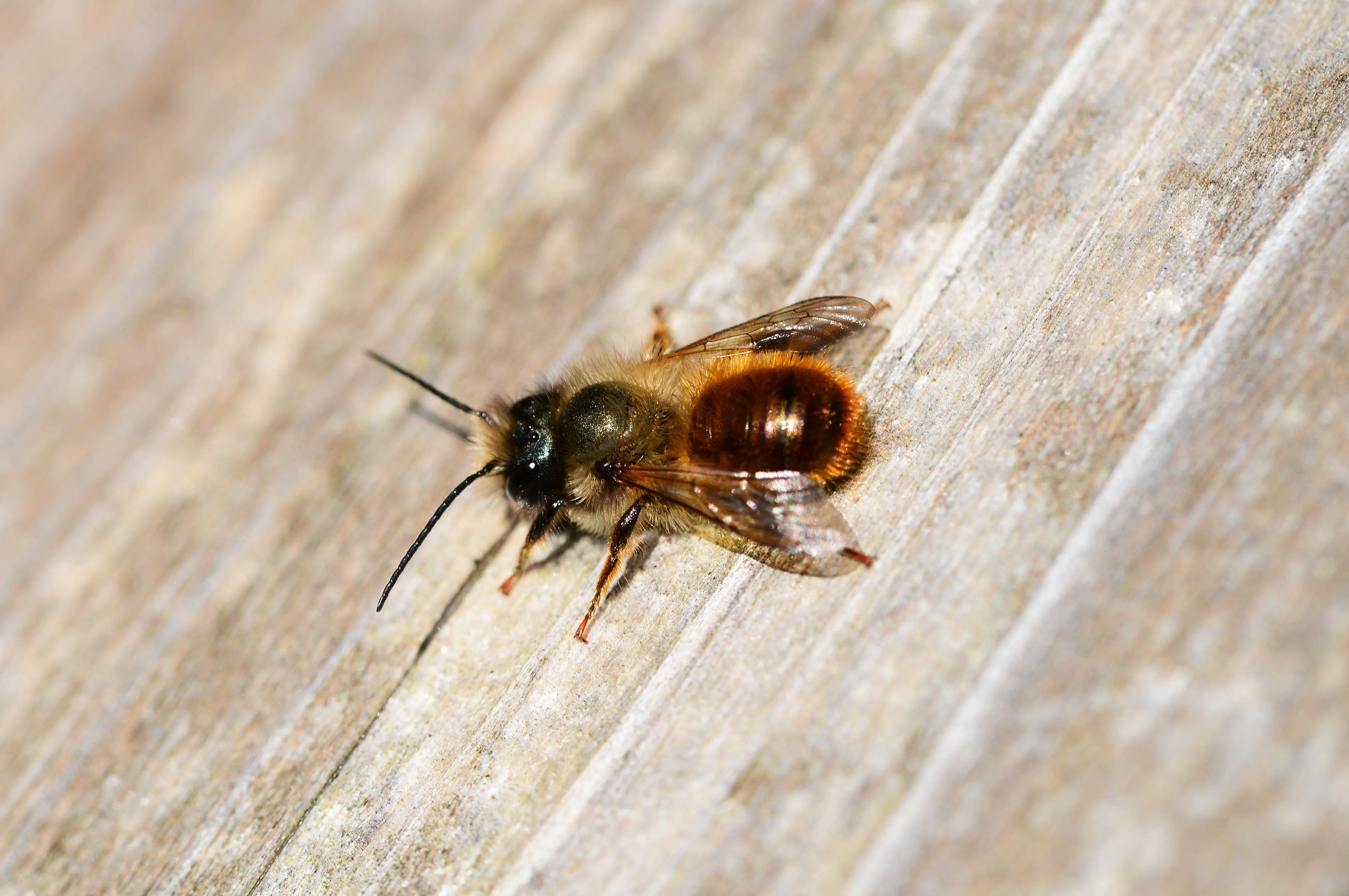
The red mason bee (Osmia bicornis) is active from March to June and is an exceptionally effective pollinator. A single female can visit up to 1,800 flowers in a day, and research on orchard pollination has shown that 250 to 300 females can effectively pollinate an entire acre of apple trees, increasing yield by up to 30%. It carries pollen dry on dense hair beneath its abdomen rather than in pollen baskets, meaning pollen falls readily onto every flower it visits. After mating in spring, each female packs nest cells with pollen and nectar, seals each cell with a mud partition, and closes the entrance with a distinctive mud plug. These mud caps, visible on bee hotel tubes from March onwards, are the clearest sign the hotel is being used.
Leafcutter bees, active from June to August, cut neat circular sections from leaves and petals to line their nest cells. They use pre-existing cavities in wood, hollow plant stems, and bee hotels. Roses, wisteria, and birch are common leaf sources. The cuts in leaves look alarming but cause no lasting harm to the plant.
The ivy bee: a newcomer worth knowing
The ivy bee (Colletes hederae) was unknown in Britain until 2001, when it was first recorded at a single site in Dorset. It has since spread remarkably: to Sussex by 2004, across most of southern England by 2009, through Wales and the Midlands through the 2010s, and recorded in Scotland and Ireland by 2021.
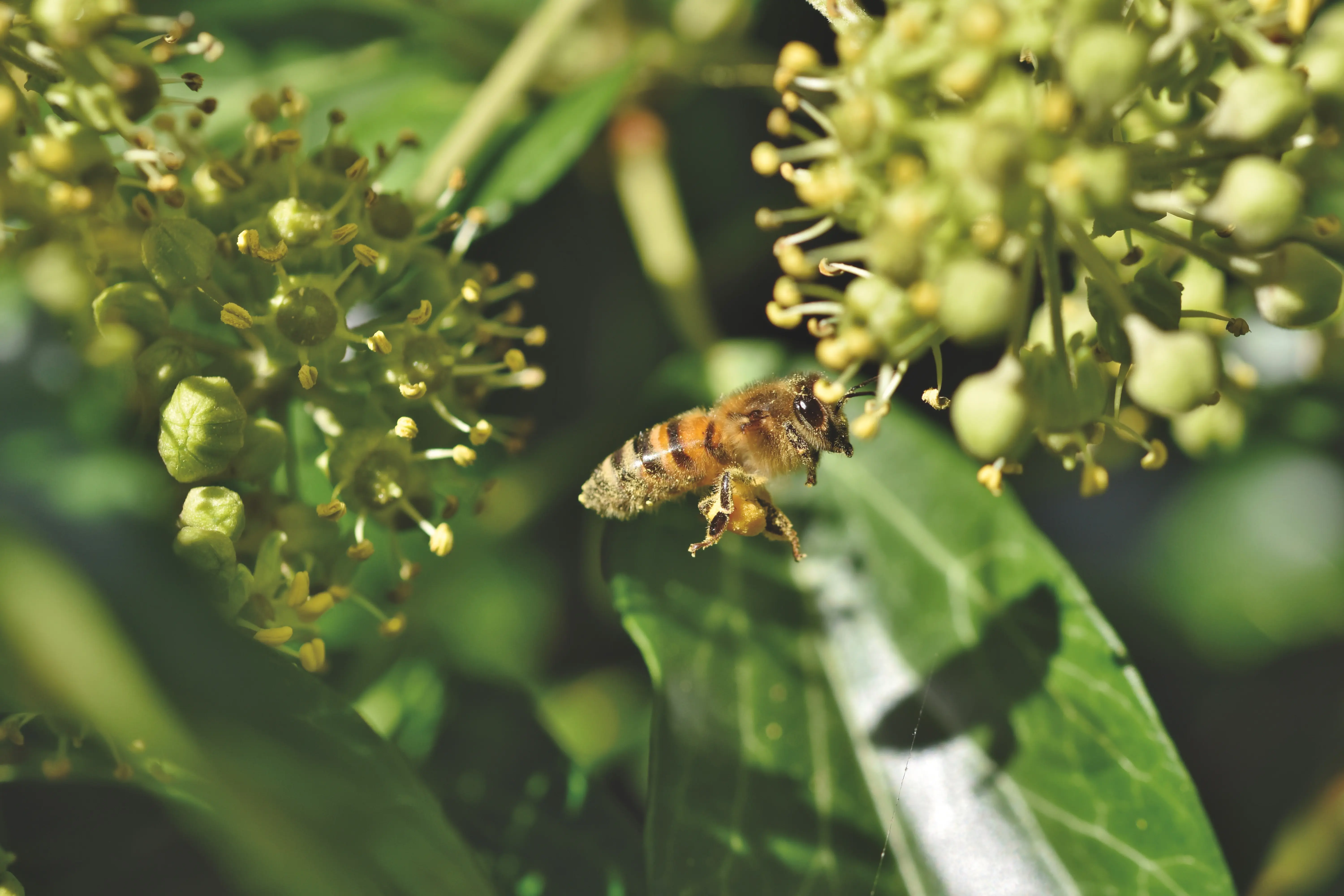
The ivy bee is almost entirely dependent on ivy pollen for provisioning its nests. It flies from early September to mid-November, coinciding precisely with ivy’s flowering period, making it the last solitary bee species on the wing each year. A Sussex survey in 2020 found it to be the second most abundant insect visiting ivy flowers, outnumbering even the honeybee. It nests in dense aggregations in loose, sandy, south-facing soil, with recorded densities of up to 300 nests per square metre. A large ivy bee aggregation in September is one of the most striking insect spectacles in the autumn garden.
The hairy-footed flower bee
The hairy-footed flower bee (Anthophora plumipes) provides a bookend to the ivy bee’s autumn season. Ginger-coloured, fast-flying, and often mistaken for a small bumblebee, the female emerges from early March and is among the first solitary bees of the year in southern England. It nests in soft mortar, cob walls, and exposed clay banks rather than in bee hotels, and has a strong affinity for tubular spring flowers: pulmonaria, red dead-nettle, comfrey, green alkanet, cowslip, and primrose. Its ability to forage at low temperatures, when honeybees rarely venture out, gives it a unique ecological role as an early-season pollinator of spring-flowering plants and fruit trees. The flight season runs from March through to June.
Why numbers are falling
Britain has lost approximately 97% of its flower-rich grassland since the 1930s. The collapse of this habitat, driven by agricultural intensification, is the single biggest cause of wild bee decline.
The causes of wild bee decline in Britain are well-documented and largely interconnected. No single factor is wholly responsible, and the picture varies by species, region, and habitat. The evidence consistently points to a landscape that has been stripped of what bees need to survive.
Habitat loss is the primary driver. Britain has lost approximately 97% of its traditional wildflower-rich grassland since the 1930s, a figure from a 1987 study commissioned by the Nature Conservancy Council and cited by the UK government, the Royal Botanic Gardens Kew, and every major conservation body. The remaining flower-rich grassland covers roughly 0.8% of England’s land. The result for bees is a landscape that is largely green but offers almost nothing to eat across much of its area: intensive pasture, arable monocultures, and closely managed verges replacing the continuous diverse supply of nectar and pollen that wild bees require.
Pesticides have compounded this significantly. Research published in Nature found that the toxic load of pesticides applied to UK farmland rose approximately six-fold between 1990 and 2015. Three neonicotinoid insecticides, clothianidin, imidacloprid, and thiamethoxam, were banned for outdoor use in the UK in 2018 after research showed they impair bee navigation, foraging efficiency, and reproductive success even at sub-lethal doses. Despite the ban, the previous government granted emergency authorisations for their use on sugar beet from 2021 to 2024, against the advice of its own scientific advisors. The current government rejected emergency use in January 2025 and is pursuing legislation to make the ban permanent. Fungicides, widely considered harmless to insects, have more recently been shown to disrupt bees’ gut microbiomes and reduce their ability to metabolise other pesticides.
Climate change introduces a more complex pressure. Research using 40 years of British bee records, published in Ecology and Evolution in 2023, found that bee emergence dates have been advancing by around four days per decade. Under a moderate climate scenario, some species could be emerging 13 days earlier by the 2070s. The risk is a growing temporal mismatch between when bees emerge and when the flowers they depend on are in bloom. Warmer winters also appear to reduce queen bumblebee survival: queens that emerge too early from hibernation can face a shortage of early flowers and exhaust their reserves before the first workers hatch.
The overall scale of loss is captured in a peer-reviewed study published in Science, which estimated that wild bee and hoverfly species in Britain lost more than 2.7 million occupied one-kilometre grid cells between 1980 and 2013. One-third of the species surveyed showed net declines across this period.
Average bumblebees seen per kilometre on BeeWalk monitoring routes in 2024, down from a peak of 14 in 2015. The BeeWalk scheme, run by the Bumblebee Conservation Trust, recorded 2024 as the worst year since monitoring began, a 22.5% fall on the 2010 to 2023 average.
What gardens can do: the evidence
Research from a collaborative study by the Universities of Bristol, Edinburgh, Leeds, and Reading found that urban areas support higher bee species richness than the surrounding farmland. Gardens cover around 30% of urban land and in the four cities surveyed produced an average of 85% of all the nectar available across those urban areas. A garden can, if planted well, provide a near-continuous supply of nectar for pollinators from March through to October. A separate study found that urban bumblebee colonies are more reproductively successful than those in agricultural landscapes.
Gardens in four UK cities produced an average of 85% of all available urban nectar. Urban bee species richness was higher than in surrounding farmland. Gardens are not a compromise habitat. In much of lowland England they are the best available.
The most important thing any garden can do is extend the season of flowers, particularly at both ends where the supply is shortest. A garden that flowers only from May to August is useful. One that provides food from February through to November, covering the full active season of Britain’s bees, is genuinely significant.
Bees in Suffolk
Suffolk sits in the driest part of Britain, and its landscape shapes which bees live here and what they need. The Sandlings, the coastal heathland belt running from the Orwell estuary north towards Lowestoft, is one of the county’s two principal areas of rare invertebrate habitat. Only around 8% of the original Sandlings heathland survives today, but what remains supports an exceptional range of ground-nesting solitary bees, many of them nationally scarce, dependent on warm sandy soil and the specific plants that grow there. To the west, the Suffolk Brecks, where sand overlies chalk and the landscape is the driest in England, have been designated by Buglife as a formal Important Invertebrate Area for their specialist calcareous grassland and heath bee communities.
Suffolk’s estuaries are among the most important sites in the world for the sea-aster colletes bee (Colletes halophilus), a coastal specialist whose entire global range is confined to the North Sea coastline and adjacent Atlantic coast of north-west Europe. It flies from mid-August to mid-October, depends almost entirely on sea aster for pollen, and nests in bare sandy soil above the saltmarsh line. The Alde-Ore, Deben, Orwell, and Stour estuaries are among its most important UK strongholds. The county also holds populations of the moss carder bee (Bombus muscorum) and the brown-banded carder bee (Bombus humilis), two of Britain’s rarest bumblebees, on coastal grassland and grazing marsh. Both are listed in Suffolk’s Biodiversity Action Plan and in the county’s 2025 Local Nature Recovery Strategy as priority species for recovery.
Suffolk Wildlife Trust manages 50 nature reserves covering 2,900 hectares across the county, many of them directly relevant to wild bee conservation. Records of bees seen in Suffolk, including garden sightings, can be submitted to the Suffolk Biodiversity Information Service at suffolkbis.org.uk, which coordinates recording across the county alongside the national BWARS scheme.
Planting for bees: three seasons
Early season Feb – Apr
This is the period of greatest scarcity and greatest need. Queen bumblebees emerging from hibernation in late February and early March have not eaten since the previous summer and must find nectar immediately. The hairy-footed flower bee appears at this time, along with the first tawny mining bee males in late March. The plants that flower now carry an outsized ecological importance.
Pulmonaria (lungwort) is one of the most valuable early garden plants for bees. It flowers from February, has abundant accessible nectar, and is the favourite early flower of the hairy-footed flower bee. Red dead-nettle (Lamium purpureum), often pulled as a weed, should be left to flower in spring as a critical early food source. Comfrey is important from March, particularly for longer-tongued species. Willow catkins, crocus, hellebores, and early fruit tree blossom all contribute to the early supply.
Mid-season May – Aug
The busiest period, when most bumblebee colonies are at peak size and solitary bee species are at their most active. The priority here is diversity: a range of flower shapes and sizes accessible to the full spectrum of bee types.
Borage and phacelia produce nectar in exceptional quantities and attract a very wide range of species. Foxglove is outstanding for long-tongued bumblebees, particularly Bombus hortorum. Lavender is reliably attractive from June to August. Alliums (flowering onions and ornamental garlic) provide accessible open flowerheads used by many species. Red clover and vetches are particularly important for long-tongued bumblebees. Fruit tree blossom in May is a significant resource for tawny mining bees and early solitary species timed to coincide with it.
Late season Sep – Nov
Often the most neglected period and, for some species, the most critical. Late bumblebee workers are foraging for winter stores. New queens are building fat reserves before hibernation. And from September onwards, the ivy bee is almost entirely dependent on what is available.
Ivy is the single most important late-season plant for British bees. Its small flowers, open from September to November, are used by ivy bees, late bumblebee workers, and several other species when almost nothing else remains. A garden with established ivy on a wall, fence, or as ground cover in a shaded corner is providing something genuinely irreplaceable. Asters, sedums, and verbena bonariensis extend the season into October. Mahonia and winter-flowering viburnums can push into November on mild days.
Nesting habitat by species type
For bumblebees
Bumblebees nest underground, most often in pre-existing cavities: old vole and mouse burrows, gaps under garden sheds, compost heaps, and dense grass tussocks at the base of hedges. They do not use bee hotels. The most useful nesting habitat a garden can offer is simply undisturbed, rougher ground: long grass left uncut through summer, a log pile in a quiet corner, or a compost heap not turned between March and August. Queens also hibernate in loose soil, often in a north-facing bank where temperatures are stable through winter. A small area of undisturbed soil at the base of a north-facing wall, left without mulch, provides suitable overwintering conditions.
For mining bees
Mining bees need bare or sparsely vegetated, south-facing soil in a sunny position. A patch roughly a metre square, without mulch and undisturbed, can attract dozens of nesting females of the same or different species. It does not need to be specially prepared: a sunny spot where grass has worn away, or a deliberately unmulched bed in a sheltered position, will be investigated quickly. The small conical mounds in lawns in April are entirely harmless. Leave them alone until the flight season ends in June.
For mason bees and leafcutter bees
These cavity-nesters use bee hotels when the hotels are well designed. They also nest naturally in hollow plant stems, holes in old timber, gaps in brickwork, and soft mortar. Leaving hollow stems of fennel, teasel, buddleja, elder, and bramble standing over winter provides natural nesting material and costs nothing. The hairy-footed flower bee, which nests in soft mortar and cob walls, is commonly attracted to old garden walls with lime or deteriorating mortar.
Bee hotels: what actually works
Research on bee hotel occupancy found that, on average, around 27% of holes are used by nesting bees, with peak use between March and May. Many commercially available hotels fall short of this because they use materials or dimensions that do not suit any local species.
A well-designed hotel for mason and leafcutter bees should have:
- Hole diameter of 2–10mm, with a range of sizes. Red mason bees prefer 6–8mm; leafcutter bees 5–6mm. Holes wider than 10mm are rarely used by British solitary bees.
- Depth of at least 10cm, ideally 15cm. Holes shorter than this do not provide enough room for viable brood cells and are typically ignored.
- Smooth internal walls. Rough surfaces increase the risk of egg-laying failures and parasites.
- A weatherproof roof that overhangs the tubes by at least 5cm. Wet nesting material becomes mouldy and kills larvae.
- A south or south-east facing position in direct sun. Warmth is essential for larval development.
Rather than one large hotel, multiple smaller ones placed in different parts of the garden are better: a large concentration of nests in one place increases the risk of parasites and disease spreading between them. Bamboo canes, common reed, or hollow plant stems cut to 15cm lengths work as well as drilled hardwood. Replace the contents every two or three years.
Avoiding harm
- Use no pesticides. No insecticide is safe for bees. The distinction between products marketed as natural and those that are not is one of degree, not of kind. An organic approach removes this risk entirely within the garden boundary.
- Check bought plants and compost for neonicotinoid treatment. Neonicotinoid-treated plants and some compost products are still sold in garden centres. These treatments persist in the soil and appear in pollen and nectar at concentrations that affect bee behaviour and reproduction. Ask at point of sale or buy from certified organic suppliers.
- Leave hollow plant stems standing until late April. Many solitary bee species overwinter as pupae inside the hollow stems of perennials. Cutting back in autumn kills them. Leave stems of fennel, teasel, buddleja, and other hollow-stemmed plants through winter.
- Check compost heaps before turning in spring and summer. Bumblebees nest in compost heaps from March onwards. An active colony is visible as a small cluster of bees near the surface. Leave it undisturbed until late summer.
- Leave mining bee nests in lawns alone. The conical mounds of tawny mining bees in April are frequently treated as a lawn problem. Each mound is the entrance to a single nest burrow used for just a few weeks. The flight season ends in June and the mounds disappear on their own. Raking, watering, or applying lawn treatments during this period destroys the nests.
- Reconsider hard landscaping. Every paved or membraned surface eliminates potential nesting habitat for ground-nesting bees. Gravel over compacted bare soil is far more permeable to nesting activity than gravel over membrane, and south-facing gravel margins are often colonised quickly.
Who is visiting: a quick guide
A few minutes of observation on a warm day between March and October, with the sun on a patch of flowering plants, will usually reveal several species. The eight species below account for most of what you will see in a Suffolk garden.
Buff-tailed bumblebee
Bombus terrestrisMar – Oct
Large and robust, with yellow and black banding and a buff-coloured tail. The most common bumblebee in gardens. Capable of buzz-pollinating tomatoes and courgettes.
Garden bumblebee
Bombus hortorumApr – Aug
Britain’s longest-tongued bumblebee. Three yellow bands and a white tail. Distinctively long face. The species most likely to be seen inside foxglove and runner bean flowers.
Red-tailed bumblebee
Bombus lapidariusApr – Aug
Unmistakable: entirely black with a bright red tail. The female workers are a striking and very easily identified garden visitor.
Early bumblebee
Bombus pratorumMar – Jul
The smallest common bumblebee, with yellow banding and an orange-yellow tail. One of the earliest species on the wing in spring and one of the first to finish for the year.
Hairy-footed flower bee
Anthophora plumipesMar – Jun
Ginger-coloured and fast-flying, often mistaken for a small bumblebee. Hovers briefly in front of tubular flowers rather than landing. Look for it on pulmonaria and comfrey in early spring.
Tawny mining bee
Andrena fulvaApr – Jun
The female is a rich rusty orange, one of the most striking solitary bees. Seen flying low to the ground near her lawn nest entrance. The small conical soil mounds in April are hers.
Red mason bee
Osmia bicornisMar – Jun
Gingery with a dark abdomen. Nests in bee hotels, hollow stems, and gaps in brickwork. Mud-capped holes in a bee hotel are her work. An outstanding pollinator of fruit trees.
Ivy bee
Colletes hederaeSep – Nov
Pale banding and a gingery thorax, slightly smaller than a honeybee. Seen almost exclusively on ivy flowers in autumn. First recorded in Britain in 2001; now widespread across England and Wales.
Photography makes identification much easier. The standard British reference is Field Guide to the Bees of Great Britain and Ireland by Steven Falk, illustrated by Richard Lewington and published by Bloomsbury. It covers all 270 British and Irish species.
Further reading and recording
-
BWARS — bwars.com
The Bees, Wasps and Ants Recording Society. Species accounts, distribution maps, and conservation status for all 270 British bee species. Garden records can be submitted directly and feed into national monitoring data. -
BeeWalk — beewalk.org.uk
The Bumblebee Conservation Trust’s national monitoring scheme. Volunteers walk a fixed route once a month from March to October, counting bumblebee species and numbers. Anyone can take part and Suffolk routes are actively needed. -
Bumblebee Conservation Trust — bumblebeeconservation.org
Species guides, conservation news, and identification resources for all 24 British bumblebee species, including Suffolk’s priority species. -
Suffolk Biodiversity Information Service — suffolkbis.org.uk
The county biological records centre. Species pages for all Suffolk priority bee species, habitat information, and a records submission portal. The primary place to log Suffolk bee sightings. -
Suffolk Wildlife Trust — suffolkwildlifetrust.org/pollinators
Habitat management guidance, nature reserve information, and the Trust’s pollinator conservation programme across the county. -
Field Guide to the Bees of Great Britain and Ireland — Steven Falk, illus. Richard Lewington (Bloomsbury)
The definitive British and Irish bee identification guide. Covers all 270 species with full-colour plates by Richard Lewington, distribution maps, and habitat notes.