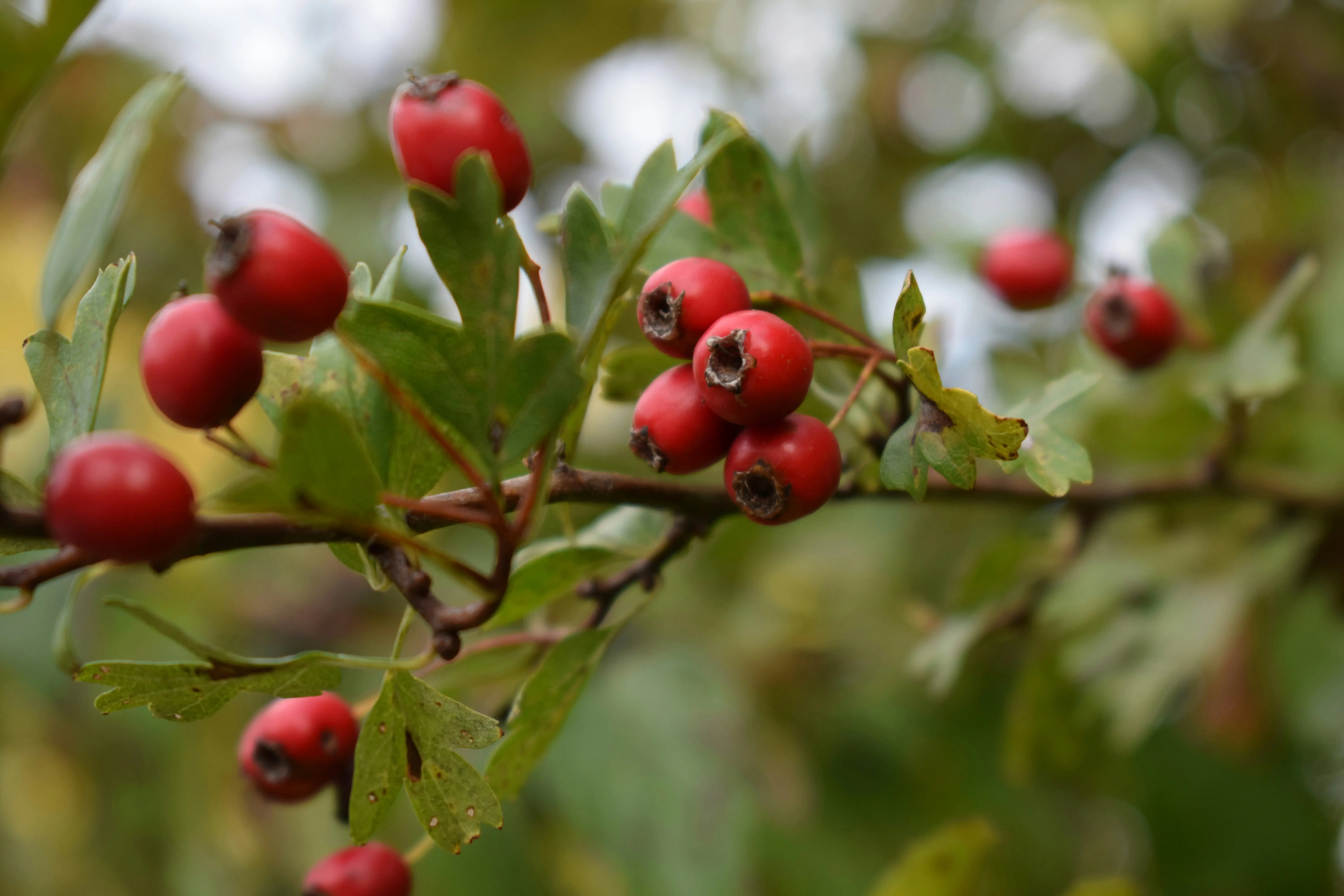
The number of insect species that hawthorn supports, more than almost any other native British plant. Of these, 149 species feed directly on the leaves, bark, or wood of the tree itself. A single established hawthorn, whether clipped into a hedge or grown as a standard, contributes more to local insect biodiversity than any ornamental alternative.
Hawthorn is the backbone of the British hedgerow. It is the most common native hedging plant in the country, making up around half of all hedgerow length, and its ecological importance goes well beyond that fraction. Across the course of a year, it provides pollen and nectar for early-flying bees and butterflies, caterpillar food for over a hundred moth species, secure nesting sites within its thorny interior, and a concentrated winter food supply for both resident and migratory birds. Few decisions a garden can make have a greater return for local wildlife.
Two native species
Britain has two native hawthorn species, which can occur together, hybridise where their ranges overlap, and are often found growing side by side in the same hedgerow. The differences between them are worth knowing, particularly in Suffolk where both are present.
Common hawthorn (Crataegus monogyna)
The common hawthorn is by far the more widespread of the two. It grows across the whole of Britain, from coastal cliffs to upland moorland, and tolerates the full range of British soils including chalk, clay, loam, and sand. It is the species that makes up the great majority of hedgerow hawthorn in Suffolk and across East Anglia. Its leaves are deeply lobed, cut more than halfway to the midrib, giving them a pointed, angular outline. Each flower has a single stigma, and each haw contains a single seed.
Midland hawthorn (Crataegus laevigata)
The midland hawthorn is native to south-east and central England and is most commonly found in the understorey of ancient woodland and in old, shaded hedgerows on heavier soils. It flowers one to two weeks earlier than the common hawthorn, a useful identification feature in late April. Its leaves are more shallowly lobed, cut less than halfway to the midrib and toothed around more of the margin. Each flower has two stigmas, and the haws contain two seeds. In parts of Suffolk, particularly on the heavier clay soils of the central plateau, midland hawthorn is present in older hedgerows alongside or instead of common hawthorn.
The two species hybridise freely and intermediate forms are common. For garden planting, common hawthorn is the more practical choice for most sites, particularly exposed positions or lighter soils; midland hawthorn is worth considering where the ground is heavy and partially shaded.
The May blossom
Hawthorn is so closely associated with May that it was simply called the May tree for centuries. Common hawthorn typically flowers from late April through to early June; midland hawthorn opens two weeks or so earlier. The timing places hawthorn blossom squarely in the spring gap when few other trees are flowering, making it a critical food source for early-season pollinators.
The flowers are small but produced in dense clusters across every branch, covering even a modestly sized tree in white. The scent is distinctive and strong, particularly in warm, still conditions. Insects visit in large numbers: solitary bees in the genera Andrena, Osmia, Halictus, and Lasioglossum are all regular visitors, as are hoverflies and honeybees. Butterflies, including the orange-tip and brimstone, both of which are early-flying species that emerge before most garden flowers are open, use hawthorn blossom as a key nectar source.
The pollen and nectar yield varies between years, appearing to depend partly on adequate winter rainfall giving the tree sufficient root moisture going into spring. In good years, the quantity of resources hawthorn puts into flower production is exceptional.
A summer of caterpillars
Once the blossom passes, hawthorn continues working. The leaves support over 300 insect species, with 149 feeding directly on the foliage or bark. This makes it one of the most ecologically productive trees in the British Isles by invertebrate count, exceeded only by oak.
The caterpillars of a large number of moth species feed on hawthorn. These include the hawthorn moth (Scythropia crataegella), the light emerald, the lackey, the vapourer, the small eggar, the lappet, the orchard ermine, and the fruitlet mining tortrix, among many others. This density of caterpillar life is not simply interesting in itself: it is the food supply that nesting garden birds depend on to raise their young. Blue tits, great tits, and song thrushes all feed their chicks primarily on caterpillars, and a hawthorn hedge provides an exceptionally rich foraging area close to nesting sites.
Beyond moths, hawthorn supports gall-forming insects, bark beetles, and a range of true bugs and flies. The accumulated invertebrate biomass in a mature hawthorn hedge represents a significant food resource for birds and bats across the whole of the growing season.
Haws: the winter larder
The haws ripen from August onwards, turning deep red by September and remaining on the branches well into winter. For many birds, particularly those arriving from northern and eastern Europe, hawthorn haws are the primary food source that makes migration to Britain worthwhile.
Redwings and fieldfares are the most conspicuous beneficiaries. Both arrive in October from Scandinavia, often in mixed flocks that strip a berry-laden hedge in a matter of days. More than 600,000 fieldfares winter in the UK each year, and research by David and Barbara Snow in the Chilterns documented that redwings show a clear preference for haws over other available berries. Song thrushes, blackbirds, mistle thrushes, and robins all eat haws, as do smaller birds including starlings and house sparrows. Wood mice cache haws in underground larders, and dormice eat them in autumn as they build the fat reserves needed for hibernation.
A hawthorn that is allowed to berry freely, whether as a tree or as a hedge trimmed on a two or three year cycle rather than annually, can produce substantial quantities of fruit. Annual hard trimming removes most of that year’s flowering and fruiting growth. Managing part of a hawthorn hedge on a longer rotation, cutting different sections in different years, maintains both structural density and berry production.
Structure and shelter
The thorny interior of a hawthorn hedge is one of the most secure nesting environments in the British countryside. Dunnocks, song thrushes, linnets, and yellowhammers all nest preferentially in hawthorn hedgerows, choosing sites where the interlocking branches and spines make access difficult for predators. Long-tailed tits use spider silk to bind their nests to hawthorn stems, relying on the surrounding thorns for protection.
Hawthorn also provides essential shelter. Dense, established hedgerows break wind, reduce moisture loss from adjacent soil, and create sheltered corridors along which hedgehogs, toads, slow worms, and small mammals move between habitat patches. The base of an untrimmed hawthorn hedge, with its accumulated dead wood, leaf litter, and bank vegetation, can support remarkable invertebrate diversity at ground level.
Hedgerows and their decline
The scale of British hedgerow loss in the twentieth century was enormous. A survey carried out in 1950 estimated approximately one million kilometres of hedgerow across England, Wales, and Scotland. By 2007, that figure had fallen to around 477,000 kilometres, a loss of more than half. In the immediate post-war period, hedgerows were being removed at a rate of around 3,000 miles per year as farms consolidated fields for mechanised agriculture.
The loss of hedgerows removed more than a boundary feature. It removed the nesting habitat, overwintering cover, invertebrate diversity, and migration corridors that rural wildlife depends on. The declines of yellowhammer, linnet, tree sparrow, and grey partridge across farmland are all directly linked to hedgerow loss and management changes. The Hedgerows Regulations 1997 gave greater legal protection to important hedgerows, making removal without consent an offence, but the existing network remains fragmented and in many cases poorly managed for wildlife.
Agri-environment schemes and conservation organisations have funded significant hedge planting in recent years, and hawthorn is the standard species used for restoration work. The garden population of hawthorn, collectively, represents a genuine addition to that network.
Hawthorn in Suffolk
Suffolk’s landscape is largely one of ancient enclosure: boundaries that predate the parliamentary enclosure acts of the eighteenth and nineteenth centuries, and which often contain a mix of hawthorn, blackthorn, hazel, and field maple rather than the single-species hawthorn hedges typical of Midlands enclosure. In parts of north-west Suffolk, the Stour Valley, and the Sandlings, parliamentary enclosure did occur, and the straight, single-species hawthorn hedges from that period can still be seen marking field boundaries across those areas.
Hawthorn is the dominant hedgerow species throughout the county. Common hawthorn is present almost everywhere; midland hawthorn is found on the heavier clay soils of the central plateau, particularly in older boundaries associated with ancient woodland edges. Both species are at home in Suffolk’s variable geology, from the chalky boulder clays of mid-Suffolk to the lighter sands of the Sandlings.
The county’s hawthorn is significant for winter thrushes. Redwings and fieldfares arrive across the East Anglian coast in October, moving inland to exploit hedgerow berries across the county. A dense, berry-bearing hawthorn hedge in a Suffolk garden is likely to receive mixed thrush flocks in most years, particularly after early frosts have started to soften the haws.
Growing hawthorn in the garden
As a hedge
A hawthorn hedge is one of the best investments a wildlife garden can make. It provides nesting habitat, berries, invertebrate diversity, and physical security simultaneously, and establishes quickly from bare-root whips planted at three to five plants per metre in a staggered double row.
Bare-root plants are available from October to February and are significantly cheaper than pot-grown stock. Whips of 40 to 60 centimetres establish as reliably as larger plants and often overtake them within two to three years. Plant in well-cultivated soil, water thoroughly during the first growing season in dry spells, and mulch the base to suppress competing grass and retain moisture.
In the first two years, cut back the leading growth by around a third each winter to encourage branching and density at the base. A hedge that is thin at ground level in its early years will remain thin there permanently. Once established, hawthorn tolerates hard pruning well and can be shaped to any profile.
As a tree
Common hawthorn grown as a standard tree is a genuinely underused garden plant. Left unpruned, it typically reaches five to fourteen metres with a broad, rounded crown. It provides spring blossom at eye level and above, summer caterpillar habitat, and a berry crop that overwintering birds can access easily. In a smaller garden where a hedge is not practical, a single hawthorn standard delivers much of the same ecological value in a compact footprint.
Hawthorn can also be managed as a multi-stem shrub, allowing it to grow with minimal intervention into a dense, thorny thicket. This form is particularly useful in a corner of the garden intended to provide nesting cover and ground-level shelter.
Soil and position
Common hawthorn tolerates virtually every British soil type, including chalk, heavy clay, waterlogged ground (though not permanently so), and thin sandy soils. It grows in full sun or partial shade and will establish in exposed positions, including coastal sites and north-facing aspects, that would defeat most ornamental hedging plants. It is fully hardy across the whole of the British Isles.
Pruning and management
The timing of hawthorn pruning matters for wildlife. Nesting season runs from March through to late August; cutting during this period risks destroying active nests and is an offence under the Wildlife and Countryside Act 1981 if it results in the taking, damaging, or destruction of a nest in use. Prune from late August through to early March, with February and March being the recommended months for any hard or formative work on established hedges, since cutting at this point encourages strong new growth in the coming season.
Annual clipping removes most of the season’s flowering and fruiting wood. For a hedge managed primarily for wildlife, a two or three year cutting rotation gives a much better balance of dense structure, blossom, and berry production. Where a neater appearance is needed, consider cutting alternate sections each year so that part of the hedge is always carrying fruit.
Hawthorn tolerates very hard pruning, including cutting back to old wood, and will regenerate reliably from stumps. Wear thick gloves and eye protection when working with hawthorn; the thorns are long, rigid, and capable of causing serious puncture wounds.
Further reading
-
Woodland Trust – Hawthorn (woodlandtrust.org.uk)
The Woodland Trust’s species account for hawthorn covers identification, ecology, folklore, and seasonal wildlife associations in detail, with reliable figures for invertebrate and bird species supported. -
People’s Trust for Endangered Species – Hedgerows (ptes.org/hedgerow)
PTES runs the National Hedgerow Survey and publishes accessible accounts of hedgerow history, decline, and restoration. The hedgerow section of their website includes both research findings and practical guidance for landowners and gardeners. -
Hedgerow Survey Handbook (Natural England / DEFRA)
The official methodology for assessing hedgerow importance under the Hedgerows Regulations 1997. Useful background for anyone wanting to understand what makes a hedgerow legally protected and what criteria are applied. -
Pollinator Monitoring Scheme – Hurray for hawthorns (ukpoms.org.uk)
A short but evidence-based piece from the UK Pollinator Monitoring Scheme on why hawthorn blossom matters for early-season pollinators, with notes on which bee and hoverfly species visit most frequently.