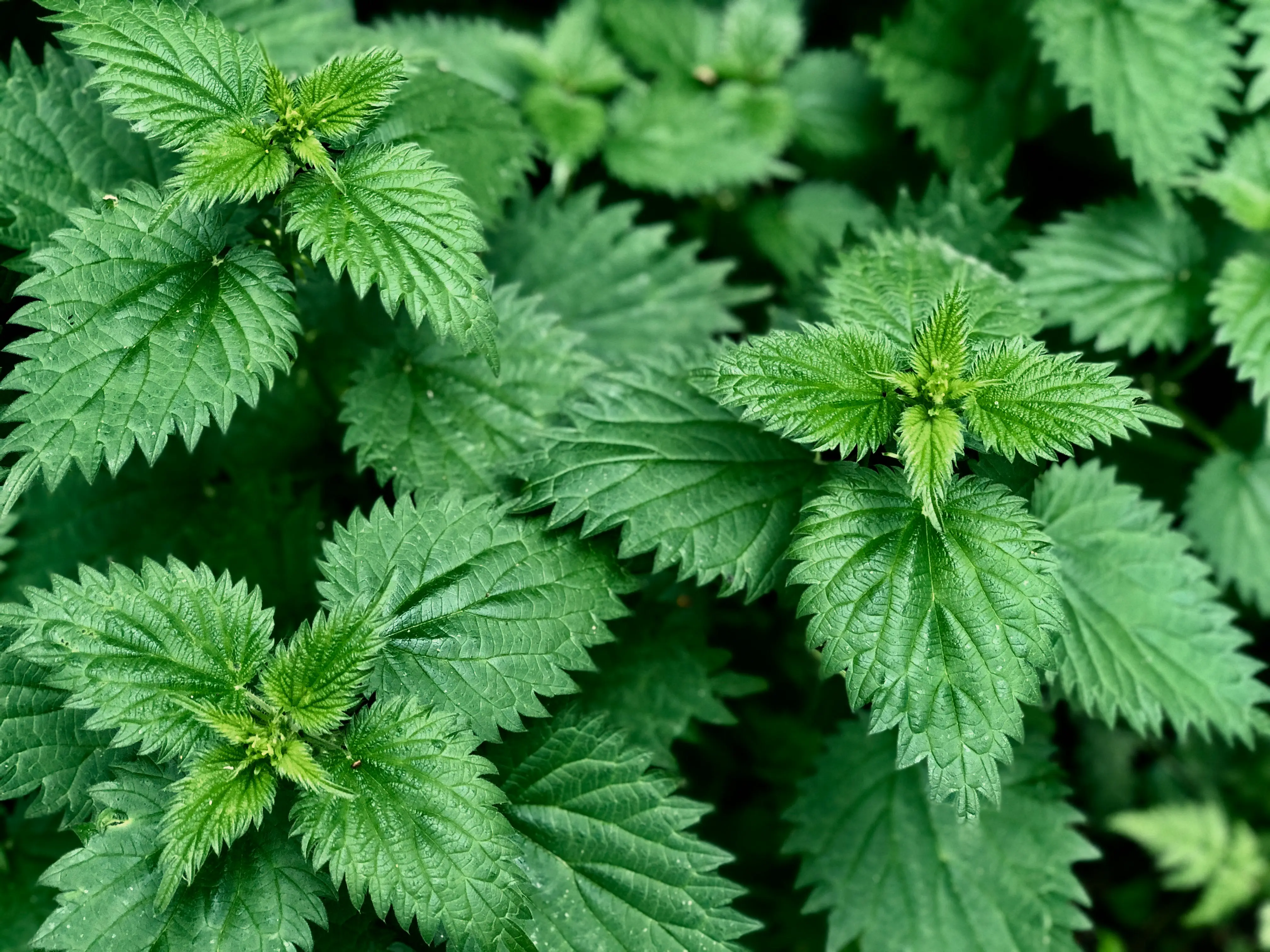
Most gardeners spend their summers trying to get rid of nettles. That instinct is understandable, they sting, they spread, and they tend to appear uninvited in the middle of vegetable beds. But outside your growing area, in a quiet corner you can afford to leave a little wilder, a patch of stinging nettles is arguably the single most wildlife-rich thing you can have.
No other common British plant supports quite the same breadth of life. Researchers have recorded over 100 invertebrate species associated with Urtica dioica, around 30 of which are specialists that rely on nettles and little else. For four of Britain’s most iconic butterflies, nettles are not just useful. They are essential.
Over 100 invertebrate species have been recorded on stinging nettles. Around 30 of them are specialists – found on nettles and almost nowhere else.
Why nettles sting
The sting is worth understanding, partly because it is remarkable, and partly because it is exactly what makes nettles so valuable to wildlife. Each hair is a hollow, needle-sharp cell tipped with pure silica. When brushed, the tip snaps off cleanly, leaving a hypodermic point that injects a cocktail of formic acid, histamine, and acetylcholine into the skin.
This deters most grazing animals, which means the plant is left largely alone. For the invertebrates that have evolved to exploit this protection, it is exactly that: a shield. Caterpillars feeding on nettles are less likely to be grazed by accident or disturbed by foraging mammals. The sting that makes you wince is the same quality that makes nettles a safe house for Britain’s butterflies.
Four butterflies that cannot exist without them
The small tortoiseshell, peacock, red admiral, and comma all lay their eggs on nettles and nowhere else as a primary foodplant. Remove nettles from the landscape and the caterpillars of these species have almost nowhere to go.
Small tortoiseshell (Aglais urticae)
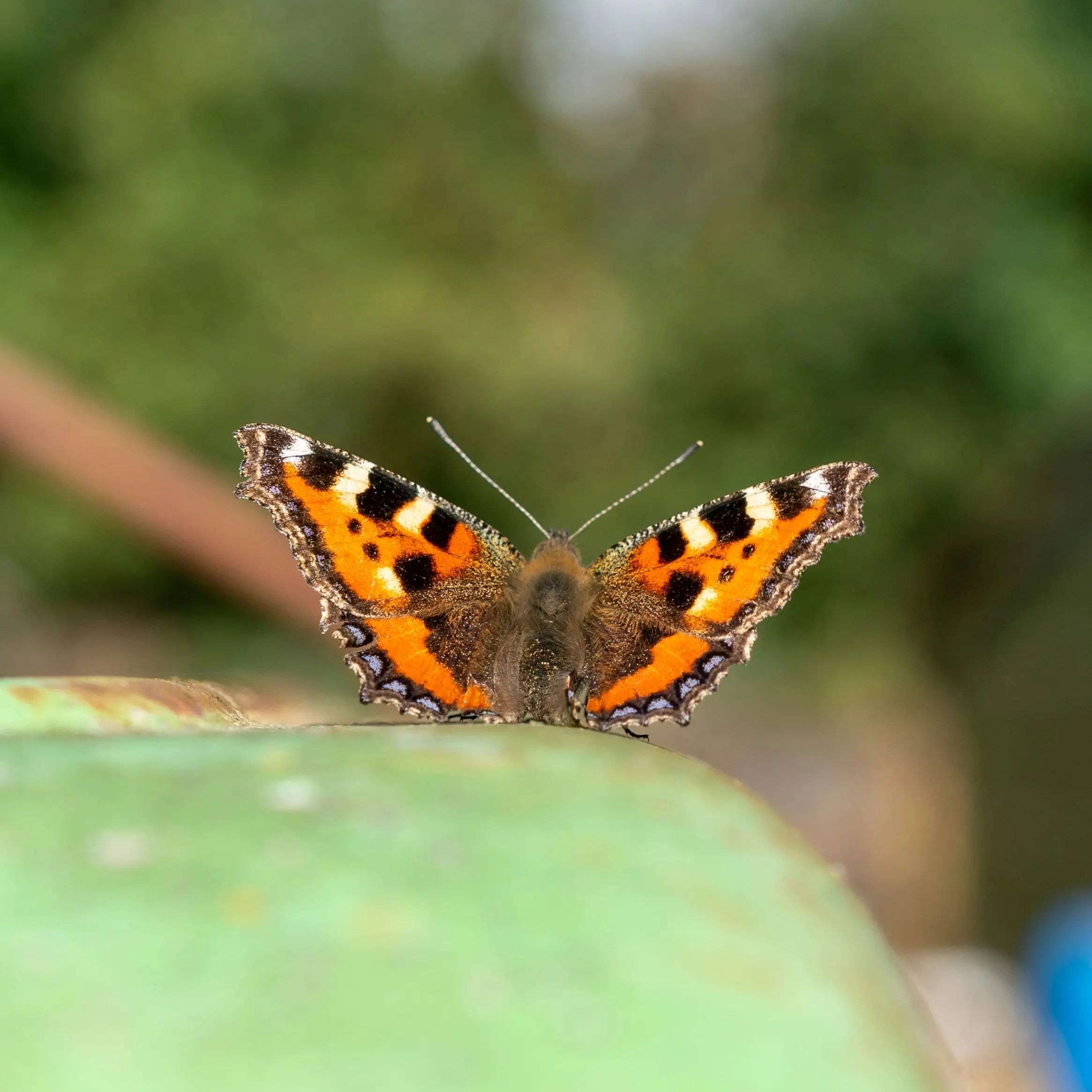
The small tortoiseshell is the butterfly most people picture when they think of a British summer, bright orange, patterned with blue spots along the wing edge, and a regular visitor to garden flowers. Its caterpillars feed almost exclusively on stinging nettles. Females lay their eggs in batches on the underside of young leaves, and the caterpillars live colonially, spinning a silk web over the shoot as they consume it together.
The species has declined by around 79% since 1976. The cause is not fully understood, though a parasitoid fly (Sturmia bella) that arrived in Britain around 1998 and lays its eggs inside caterpillars is known to be a significant factor. What is clear is that wherever nettles grow well, small tortoiseshells tend to follow. Maintaining a good nettle patch is one of the most direct things a gardener can do for this species.
The small tortoiseshell has declined by around 79% since 1976, making it one of Britain’s most threatened common butterflies.
Peacock (Inachis io)
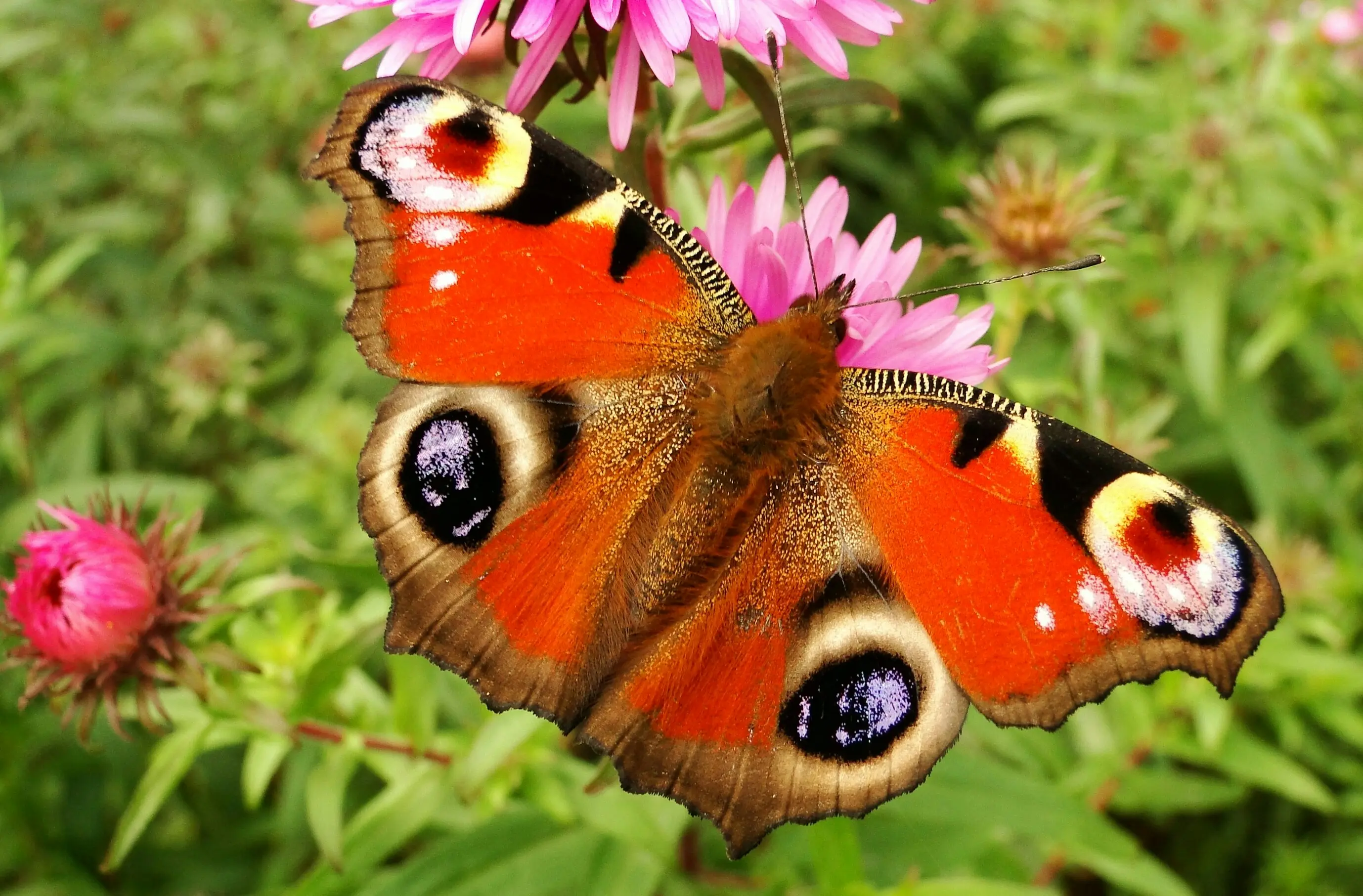
The peacock is hard to mistake: four vivid eye-spots on wings the colour of deep red wine. Like the small tortoiseshell, females lay eggs in batches and the caterpillars feed together in a group, sheltering in a loose silk web and moving on once they have exhausted one section of the plant. Peacock caterpillars are jet black with fine white spots and small spines, and can be spotted quite easily on nettle shoots in late spring and early summer if you look closely.
Red admiral (Vanessa atalanta)
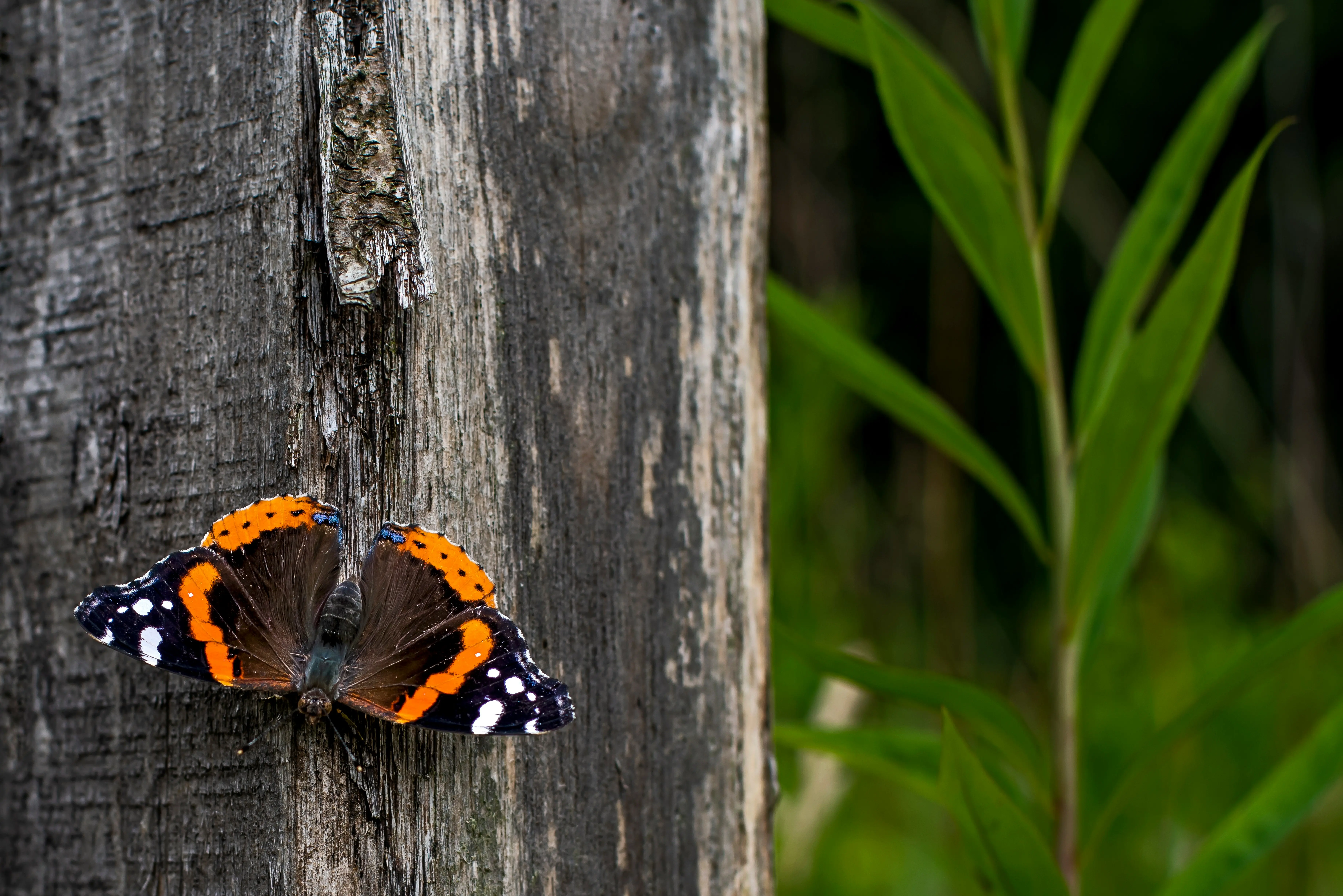
The red admiral is one of the most striking butterflies in Britain, with its vivid orange-red bands on black wings. Unlike the tortoiseshell and peacock, red admiral caterpillars are more solitary, each one folding a nettle leaf around itself to create a protected tent, feeding inside it, and moving to a new leaf once the first is exhausted. Most red admirals in Britain each year have migrated from southern Europe, though a small number overwinter here in mild years.
Comma (Polygonia c-album)
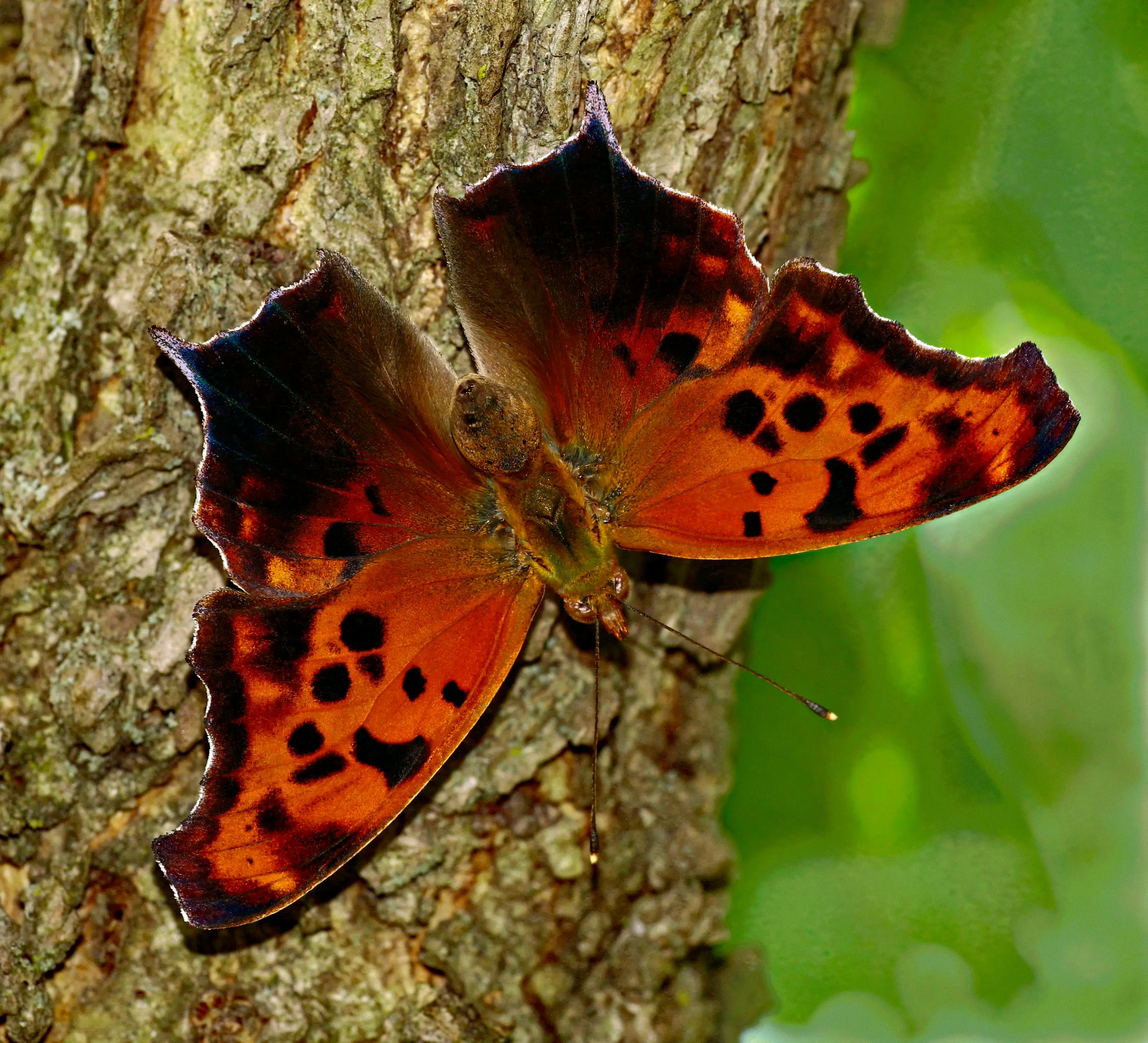
The comma is named for the small white comma-shaped mark on the underside of its ragged-edged wings, which makes it look convincingly like a dead leaf when resting. Its caterpillars also use nettles as their primary foodplant, though they will occasionally use hops as an alternative. The comma has actually expanded its range northwards in recent decades, one of the few British butterflies currently doing so, and nettle availability is thought to be a supporting factor.
Moths, beetles, and over 100 other species
The butterflies get most of the attention, but the wider invertebrate community supported by nettles is just as significant. Around 30 of the 100-plus species recorded on Urtica dioica are specialists, meaning they are found on nettles and on very little else.
Several moth species use nettles as a larval foodplant, including:
- Mother of pearl – a beautiful iridescent moth whose caterpillars spin leaves together
- Burnished brass – named for its metallic gold-green wing patches
- Snout – distinctive for its long labial palps that resemble a snout
- Jersey tiger and ruby tiger – striking day-flying species
- Spectacle – so named for the pattern of rings around its eyes when viewed from the front
- Beautiful golden Y and angle shades
- Nettle-tap (Anthophila fabriciana) – a tiny micro-moth that flies actively around nettles in daylight, often mistaken for a small fly
Beyond moths and butterflies, nettles support lacewings, ground beetles, earwigs, hoverflies, spiders, and a range of plant bugs. Aphids are attracted to nettles in large numbers, which in turn draws aphid predators: ladybirds, lacewing larvae, and hoverfly larvae all benefit. The nettle patch becomes a self-sustaining food web, supporting predators as well as plant-feeders.
The hollow stems of mature nettles also provide overwintering habitat for small beetles and bugs, which is another reason to leave some stems standing through winter rather than cutting everything back in autumn.
How nettles feed the birds
Each nettle plant produces thousands of small seeds in late summer and autumn. Chaffinches, bullfinches, and house sparrows all feed on them directly. House sparrows are in significant decline across Britain, and any additional seed source in a garden has real value for local populations.
Beyond the seeds, the insects that live on and around nettles throughout the spring and summer provide food for a wide range of garden birds. Blue tits, great tits, wrens, and robins all hunt the invertebrates that nettles attract. A patch of nettles in a garden is not just a habitat in itself; it is a food source that radiates outward through the whole garden ecosystem.
Starting a nettle patch
You almost certainly do not need to plant nettles. If your garden has any bare, damp, reasonably fertile soil, they will find it. The more useful question is where to let them establish and how to keep them in the right place.
The ideal spot is a corner that receives at least some sun, preferably south or east-facing, and that does not need to be formally maintained. The edges of a garden, a strip along a fence, or the area around a compost heap are all good choices. A patch of around one to two square metres is enough to make a real difference to local butterflies. Larger is better, but even a modest patch in the right location will be used.
If you need to establish nettles deliberately, dig up a small clump with roots from a wild area (ask the landowner first) and replant into moist, fertile soil. They will establish readily and spread from the root system over subsequent seasons.
Managing the patch
A completely unmanaged nettle patch will gradually spread and may outcompete smaller plants nearby. A little regular management keeps it productive and contained without reducing its wildlife value.
- Cut back the edges two or three times a year using a spade or border fork to remove rhizomes that are creeping beyond the intended area.
- Remove flowerheads before they set seed if you want to limit spread. If you are happy for the patch to stay roughly where it is, leave them for the birds.
- Do not cut everything back in autumn. The hollow stems are used as overwintering shelter by beetles and other insects. Leave some stems standing until late February or early March, then cut them to ground level before new growth appears.
- Consider a spring cut in one part of the patch around May. This produces a flush of fresh young growth that is particularly attractive to egg-laying butterflies later in the season, giving you two cycles of caterpillar activity on the same patch of ground.
Making nettle liquid feed
While your nettle patch is doing its work for wildlife, it can also supply a free, effective organic fertiliser for your vegetable plants. Nettle feed has a high nitrogen content (approximate NPK of 2.0–0.5–1.5), which makes it particularly useful for leafy crops and for establishing young plants early in the season.
- Pack a bucket loosely with freshly cut nettle stems and leaves.
- Weigh the nettles down with a brick or stone to keep them submerged.
- Cover with water to about three-quarters full.
- Put a loose lid on and leave to steep for two to four weeks, stirring occasionally. The liquid will turn dark brown and smell strongly: both are signs it is working.
- To use, dilute one part feed to ten parts water for watering at the root, or one part to twenty for foliar application.
Nettle feed is best suited to leafy crops such as lettuce, spinach, kale, and chard, and to brassicas and courgettes earlier in the season. It complements comfrey feed well: nettles provide nitrogen for leafy growth, while comfrey provides the potassium that fruiting plants need once they start to flower. Used together, they cover the full growing season without spending a penny.
See our comfrey liquid feed guide for the potassium-rich alternative.
Eating nettles
Young nettle tips, the top four to six leaves of new spring growth, are edible and nutritious. Cooking destroys the sting completely, and the flavour is somewhere between spinach and a mild, earthy green. They are particularly rich in iron, as well as vitamins A and C.
Harvest in early spring before the plant flowers, wearing gloves and using scissors to take just the top growth. Once nettles have begun to flower, the leaves develop compounds that can irritate the kidneys and are best left alone for eating. Steam or simmer the young tips for two to three minutes and use wherever you might use spinach: in soups, folded through gnocchi, blended into pesto, or simply wilted with butter and a little nutmeg.
If your patch provides more nettle tops than you can use immediately, they freeze well once blanched.
Further reading
-
Butterfly Conservation (butterfly-conservation.org)
Species accounts and conservation status for all UK butterflies and moths, including the four species that use nettles as their sole larval food plant. Habitat guidance for anyone wanting to support these species in their garden. -
Buglife (buglife.org.uk)
The invertebrate conservation charity. Detailed information on the species that depend on nettles, wider guidance on managing gardens for invertebrates, and the B-Lines project mapping pollinator corridors across the UK, including Suffolk. -
Garden Organic (gardenorganic.org.uk)
Practical guidance on nettles as a garden resource, covering use as a liquid feed, companion plant, and wildlife habitat. Organic management advice for anyone wanting the ecological benefits without uncontrolled spread. -
iRecord (irecord.org.uk)
Submit records of butterflies, moths, and other invertebrates seen on or near your nettle patch. Records feed into national monitoring datasets and help track the distribution of nettle-dependent species over time.